

Violent by Design sounds like it was made for an arena, but it was recorded in Stoupe the Enemy of Mankind’s bedroom, without a mic booth or soundproofing, on equipment bought with the money from the group’s debut EP. That gap between epic scale and modest means runs through the whole Jedi Mind Tricks story. Vinnie Paz and Stoupe the Enemy of Mankind were high school friends when they founded the group in Philadelphia in 1996. Twenty-five years later, they had released ten studio albums and sold hundreds of thousands of records, all of them independently.
The first full-length, The Psycho-Social, Chemical, Biological & Electro-Magnetic Manipulation of Human Consciousness (1997), introduced Paz, then going by Ikon the Verbal Hologram, with a cosmic, paranoid style. Stoupe was already digging through obscure records for orchestral passages and dark loops he could stack into dense, meticulously layered beats. By Violent by Design (2000), Paz had changed his name and swapped the cosmic paranoia for violent, mythological imagery. With Jus Allah next to him on the mic, the group’s confrontational style reached its fullest expression on songs like “Retaliation,” “Heavenly Divine” and “Genghis Khan.” It is still one of their high points.
Visions of Gandhi (2003) moved the operation into a professional New York studio and leaned into Latin samples, percussion and big orchestral flourishes. Some longtime fans didn’t follow, but the adventurous production and guest spots from Kool G Rap and Canibus make it an underrated part of the catalogue. Legacy of Blood (2004) kept the run going with Sean Price, Killah Priest and GZA. Two years later, Servants in Heaven, Kings in Hell produced one of the group’s defining moments in “Uncommon Valor: A Vietnam Story,” where R.A. the Rugged Man tells his father’s war story with a weight that cuts through the usual battlefield imagery.
The lineup kept changing after that. Jus Allah came and went more than once, and Stoupe sat out Violence Begets Violence (2011) before returning to produce every track on The Funeral and the Raven (2021). Paz kept a busy solo career and the Army of the Pharaohs collective going on the side. Ranking these ten albums means following a producer’s sample crates as closely as a rapper’s pen, since the records usually rose or fell with Stoupe’s presence.

10. Violence Begets Violence (2011)

Vinnie Paz and Jus Allah got tired of waiting for Stoupe to be in the right mood to make another Jedi Mind Tricks record, so they went ahead without him. The result is the only JMT album with no Stoupe production, and his absence shows. The record sounds unfocused in places and makes some questionable musical choices. The worst is “Chalice,” an awful reggae-flavored detour with Chip Fu.
Most of the lesser-known producers who took over do capture the hardcore JMT sound. C-Lance handles four tracks, including “Imperial Tyranny” with King Magnetic. Hypnotist Beats gives Demoz and the two MCs a bruising backdrop on “When Crows Descend Upon You,” and Junior Makhno’s “F**k Ya Life” with Blacastan hits as hard as anything here. Over these beats, Jus and especially Paz rap harder than ever, and sometimes over the top. Their bars lean toward grotesque expressions of hate and rage, close to full horrorcore. The socio-political and religious-philosophical threads that used to run through the brutal battle verses of earlier albums mostly disappear.
It’s the weakest album in the catalogue. Those three standouts keep it from being dismissed completely, but they’re not enough to cover for the producer who wasn’t there. | 6.5/10
9. The Funeral and the Raven (2021)

Three short interludes sung by Yes Alexander split The Funeral and the Raven into acts: “Pathogen,” “We Tolerate the Sickness” and “Until the Void Consumes Us.” This is the last part of the trilogy that started with The Thief and the Fallen in 2015 and continued with The Bridge and the Abyss in 2018. Vinnie Paz, Stoupe and DJ Kwestion run it like a closing chapter, with no wasted motion and no real weak points.
Stoupe produced the whole album, and 7L drops in with cuts on four tracks, including “Crematorium” with Pro Dillinger, one of the standouts. “Manufacturing Consent” is built on a sample from Marijata, and “The Death of One Man Is a Tragedy, the Death of 10,000 Is a Statistic” is the album’s most thought-provoking moment. “Abdallah Azzam Brigade” is a banging bar fest, with Recognize Ali, Demoz, Ill Bill, and Chinaski Black lined up next to Paz. “The Great Derangement,” a sobering closer featuring Thea Alana, brings things down.
It isn’t the group’s best album, and it isn’t trying to be. It’s a worthy addition to the catalogue. It came out almost 25 years after The Psycho-Social CD, and nothing on it sounds tired. | 7/10
8. A History Of Violence (2008)

“Deathbed Doctrine,” “Heavy Artillery,” “Butcher Knife Bloodbath,” “Death Messiah”: the tracklist reads like a warning label, and the album delivers on every title. A History Of Violence is not Jedi Mind Tricks’ best album, but it’s nowhere near as bad as some critics made it out to be. The lyrical imagery is classic JMT, hard as nails and brutal, and the 45-minute running time keeps it tight.
The big news was Jus Allah’s return, and he fits back in like a glove. His verses trade off naturally with Vinnie Paz’s, as if the eight years since Violent by Design had never happened. Stoupe produced every track, and his beats are dope throughout. “Monolith” and “Godflesh” were the singles, and the second gives Block McCloud and King Magnetic room to work. Block returns with Demoz on “Deadly Melody,” and OuterSpace and Doap Nixon join for “Seance of Shamans.” Three of Stoupe’s short instrumental interludes break up the album without slowing it down.
It’s a solid follow-up to Servants In Heaven, Kings In Hell (2006), which is admittedly the better record. It was also the group’s last album on Babygrande. The next one, made without Stoupe, sits at the bottom of this list. | 7/10
7. The Thief And The Fallen (2015)

The album closes with “Lemarchand’s Box,” named after the puzzle box in Clive Barker’s horror fiction, and Barker’s writing partly inspired Vinnie Paz’s lyrics here. That literary edge suits the reunion. For the first time since A History of Violence, Paz and Stoupe were making a record together again, with DJ Kwestion still at their side. Jus Allah, meanwhile, had left for the second time.
With Stoupe back on the boards for every track, the classic JMT boom-bap sound returns. The songs are compact, most well under four minutes. The opener, “Poison in the Birth Water,” gets straight to the point and is one of the best things on the album. “Hell’s Messenger” keeps the pressure up, and Dilated Peoples join Paz on “The Kingdom That Worshipped the Dead.” Yes Alexander sings two interludes with Italian titles, and the Italian thread continues on “Fraudulent Cloth,” which credits Albano Carrisi as a writer.
The centerpiece is “And God Said to Cain,” with Eamon on the hook and A-F-R-O and R.A. The Rugged Man on the mic, two rhyme machines who are hard to match. Paz matches them anyway. His epic verse even outdoes R.A., which very few rappers have managed on a shared track. | 7/10
6. The Bridge And The Abyss (2018)

Eight Jedi Mind Tricks albums, four Vinnie Paz solo records, and a stack of Army of the Pharaohs and other affiliated releases: the formula was no secret. Fans expected banging beats and brutal bars, and The Bridge And The Abyss delivers both in full.
Stoupe produced the whole album, this time with C-Lance, Aaron Hiltz, and Scott “Supe” Stallone as co-producers on several tracks, and the extra hands make the low end heavier without blurring his signature. “Hell’s Henchman” and “You Have One Devil but Five Angels” are classic JMT joints, with Paz barking over dark, dramatic loops. “Torture Chamber” brings in Czarface, which links Paz with Inspectah Deck and with Esoteric, who goes back to the earliest Army of the Pharaohs lineup. On “Legacy of the Prophet,” Paz shares the mic with the late Sean Price. Yes Alexander, now a fixture, sings four interludes that let the beats breathe between the onslaughts.
Twenty-two years after the group started, giving fans exactly what they expect is harder than it sounds, and JMT makes it look easy. | 7.5/10
5. The Psycho-Social, Chemical, Biological & Electro-Magnetic Manipulation Of Human Consciousness (1997)

The title comes from Valdamar Valerian’s Matrix III, a 1,900-page conspiracy tome. It was one of the “crazy books” Vinnie Paz said fed into the album, and it shows. Songs like “Communion: The Crop Circle Thesis” and “The Immaculate Conception” mix astronomy, religion, violence, and secret history into lyrical wizardry that’s often esoteric but never dull. Jedi Mind Tricks hadn’t reached their full potential yet, but this is a dope album anyway.
Vinnie Paz gets the words, but Stoupe the Enemy of Mankind sets the mood. His beats are mid-tempo and symphonic, bone-chilling and atmospheric, with enough space for Paz’s paranoid rhythms to move around. “The Winds of War” opens with that atmosphere at full strength. Breath of Judah joins on “Chinese Water Torture” and comes back with Apathy for “The Three Immortals,” and “I Who Have Nothing” closes the original sequence on a high.
First pressed as 1,000 vinyl copies, the album reached a wider audience in 2003, when its CD reissue became the first Hip Hop release on the young Babygrande label. Among the reissue’s bonus tracks, recorded before the album itself, is “Get This Low,” featuring Black Thought and Jus Allah. Innovative and intelligent, it kicked off an impressive career for Jedi Mind Tricks, and the rest of the story was already in the room. | 7.5/10
4. Legacy Of Blood (2004)

GZA turns up twice on Legacy Of Blood, on two mixes of “On the Eve of War” named after the boxers Julio César Chávez and Meldrick Taylor. It’s a fitting nod on a record by an MC who took his own name from a fighter. Jedi Mind Tricks kept guests to a minimum this time, and with only four of them, every appearance counts.
Coming off the divisive Visions of Gandhi, the group steered back toward the grittier boom-bap of Violent by Design. Stoupe’s beats are more straightforward here, bass-heavy and booming in his familiar way, with a few traces of Latin-flavored sampling left over. Vinnie Paz sticks to his usual material: violent imagery, his ideas about religion, philosophy, and history, and verbal attacks on governments and on groups of people he dislikes, which brings back some of his seemingly inevitable homophobia. Whatever the target, the bars are aggressive and hit hard.
“The Age of Sacred Terror” sets that tone early. “Saviorself,” a dope duet with Killah Priest, is a standout, and so are “The Philosophy of Horror” and “Me Ne Shalto.” Sean Price drops by for “Beyond the Gates of Pain.”
It’s a strong album, the sound of a group pulling back toward what it did best after a year of experimenting. | 7.5/10
3. Visions of Gandhi (2003)

Vinnie Paz handles the mic alone on only a couple of songs here. Everywhere else he has company, and the lineup is stacked: Kool G Rap on “Animal Rap,” Canibus on “Tibetan Black Magicians,” Ill Bill on “The Wolf,” and Tragedy Khadafi and Goretex on “Kublai Khan.” Ras Kass on “Rise of the Machines” and Percee P on “Walk With Me” do the most damage, proving again why they belong among the best MCs ever.
That deep bench matters, because Visions of Gandhi has always split opinion, especially among early fans. The critics have a list. With Jus Allah gone, they say, the group lost much of its intelligence. Stoupe, now working in a professional New York studio, got too polished and too fond of Latin flavors and grand orchestral samples that clash with Paz’s rugged rhyming. Paz himself got less conscious, more repetitive, and more intent on shocking people, and his homophobia gets tiring. There’s some truth in all of it. But judge the album on its own terms instead of against the rest of the catalogue, and it’s a dope record. Stoupe’s beats may be glossy, but they bang and are mostly excellent.
Paz took the title from a Foxy Brown verse on Nas’s “Affirmative Action.” He said the war in Iraq, the situation in Palestine, and Mumia’s imprisonment made him feel the world needed someone like Gandhi. Heard that way, the album is a plea for peace delivered entirely in the language of war. | 8/10
2. Violent By Design (2000)
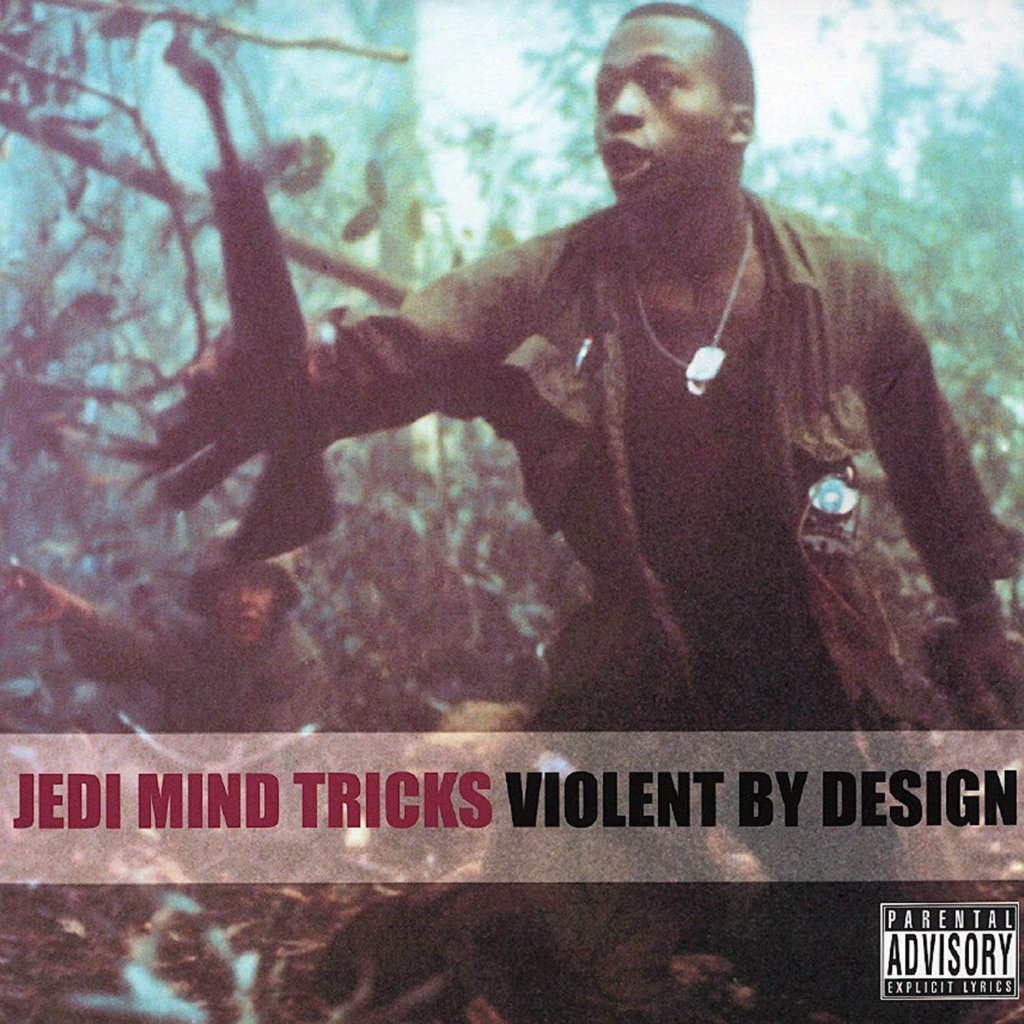
The cover is Joel D. Meyerson’s photograph of an American soldier calling for a medic during the Battle of Dak To in 1967. Inside the digipak, there’s an image of the execution of Nguyễn Văn Lém. Jedi Mind Tricks wanted listeners to know what they were in for, and Violent By Design delivers. Vinnie Paz had left the cosmic conspiracies of the debut behind for something harder and more rugged, and his violent bars are mixed with what remained of the old metaphysics. Some of it is hard to stomach, especially the anti-Christian and homophobic lines that drew criticism at the time.
The new third voice made a big difference. Camden, New Jersey MC Jus Allah was never officially inducted, but he raps on every non-Army of the Pharaohs track, and the credits never list him as a featured guest. His menacing cadence pushes Paz, and the two rip through the tracks with sick flows and clever punchlines.
Stoupe holds it all together. He works from movie scores, Latin records, film dialogue, and readings of Wilfred Owen’s poetry, and builds them into moody, string-heavy beats that are as good as you could wish for. “Sacrifice” is the high point, with “The Deer Hunter,” featuring Chief Kamachi, close behind. Mr. Lif on “Speech Cobras” and Bahamadia on “Exertions (Remix)” give the rest of the cast plenty to live up to.
With a Vietnam photograph on the cover and First World War poetry in the samples, Violent By Design builds its brutality on a century of other people’s battles. | 8.5/10
1. Servants in Heaven, Kings in Hell (2006)

Slayer, Trivium, Amorphis, and Sinergy each had a song called “Serenity in Murder,” “When All Light Dies,” “Black Winter Day,” or “Razorblade Salvation” before Jedi Mind Tricks borrowed the titles. The lead single is called “Heavy Metal Kings,” with Ill Bill sharing the mic, and Vinnie Paz name-checks Cannibal Corpse and The Dillinger Escape Plan in his bars. The metal fandom was always part of JMT. On their fifth album, it became a frame for the group’s best record.
The album is worth the price of admission for “Uncommon Valor: A Vietnam Story” alone, a masterpiece built around an epic verse by R.A. the Rugged Man. But every track works. Stoupe’s cinematic soundscapes and Paz’s vicious lyrics get equal shine, and the range is wider than on Visions of Gandhi or Legacy of Blood. Shara Worden of My Brightest Diamond sings on “When All Light Dies” and “Razorblade Salvation,” bringing a fragile voice into Stoupe’s heaviest arrangements. Sean Price and Block McCloud trade verses on “Outlive the War,” and longtime collaborator Chief Kamachi joins Reef the Lost Cauze on “Gutta Music.”
It was the group’s best-selling album and their first to reach the Billboard 200, yet next to the pop-rap from Lil Wayne, Rick Ross, and others that ruled 2006, it went criminally unnoticed. Four of its titles came from metal bands. Everything else about it belongs to Jedi Mind Tricks. | 9/10