

Pharoahe Monch has built a career around an extraordinary command of language and an unusually broad approach to MCing. The Queens, New York native is celebrated for his elaborate rhyme schemes, internal rhymes, multisyllabic patterns, and remarkable breath control, but technical ability is only part of his appeal. Monch is equally compelling as a storyteller, social commentator, humorist, and conceptual writer. Across three decades, he has used Hip Hop to explore personal experiences, political issues, violence, identity, and the absurdities of everyday life, developing a catalogue that rewards close listening.
The name Monch originated with a childhood nickname. After a bad haircut left him resembling a chimpanzee, classmates at New York’s High School of Art and Design started calling him Monchhichi, after the monkey doll. The nickname was eventually shortened to Monch. The Pharoahe prefix came later, following his meeting with future Organized Konfusion partner Prince Po.
Together, Pharoahe Monch and Prince Po released three albums as Organized Konfusion: the self-titled Organized Konfusion (1991), Stress: The Extinction Agenda (1994), and The Equinox (1997). Handling much of the production themselves, the duo developed a distinctive style characterized by adventurous arrangements, unconventional subject matter, complex rhyme structures, and two highly complementary MCs. All three records received positive critical reviews, although commercial success proved elusive. Following The Equinox, the partnership came to an end.
Monch subsequently signed with independent label Rawkus Records. After attracting attention through guest appearances, including his contributions to the influential compilation Soundbombing II, he released his long-awaited solo debut, Internal Affairs, in 1999. Its lead single, “Simon Says”, became a major underground and crossover success. Built around a sample from Akira Ifukube’s soundtrack to Gojira Tai Mosura, the song also landed Monch in legal trouble over its uncleared use. The resulting lawsuit disrupted distribution of the album.
The years following Internal Affairs brought relatively little solo material, although Monch continued making notable appearances. In 2000, he joined Mos Def and Nate Dogg on “Oh No“, from Lyricist Lounge 2. Three years later, he released “Agent Orange”, a war-themed track through Rawkus that revisited ideas from Organized Konfusion’s 1991 song “Releasing Hypnotical Gases”.
Monch returned with Desire in June 2007, embracing a distinctly soulful and gospel-influenced direction. He described the album as a fresh sound for him, and its lead single, the self-produced “Push”, offered an early indication of that musical shift. Four years later, W.A.R. (We Are Renegades) brought a more politically charged perspective, addressing themes of resistance, power, and social injustice. Its conceptual successor, PTSD: Post Traumatic Stress Disorder, followed in April 2014 through his independent label W.A.R. Media. Featuring the Lee Stone-produced singles “Damage” and “Bad M.F.”, the album explored the psychological consequences of violence and trauma.
Monch expanded his musical horizons again in 2021 with A Magnificent Day for an Exorcism, the debut album by th1rt3en, a rock-rap trio featuring guitarist Marcus Machado and drummer Daru Jones alongside Monch.
For this ranking, we examine eight full-length projects on which Pharoahe Monch played a major creative role: his four solo albums, three Organized Konfusion albums with Prince Po, and the th1rt3en album. Together, they trace the development of one of Hip Hop’s most distinctive writers and performers across three decades.

8. th1rt3en - A Magnificent Day For An Exorcism (2021)

After seven years without a full-length release, Pharoahe Monch returned in an unexpected musical setting. A Magnificent Day for an Exorcism is the debut album by th1rt3en, a trio consisting of Monch on vocals, guitarist Marcus Machado, and drummer Daru Jones. The project takes Monch into rock territory, with Machado’s electric guitar and Jones’ live drumming giving the music a considerably different character from his previous solo work.
Monch has never been particularly prolific. His catalogue consists of three albums with Organized Konfusion, four solo records, and now this collaboration. The relatively small output has generally come with a high standard of writing, and Monch’s contribution here is no exception. Three decades into his recording career, his command of rhyme and language remains exceptional. His delivery has evolved over the years, with a different vocal character from the more animated performances of his Organized Konfusion days, but his ability to construct dense, purposeful verses is intact. There are even occasional attempts at singing, although rapping is clearly where his strengths lie.
The subject matter is familiar territory for Monch. Racism, consumerism, police brutality, corruption, and the abuse of power all receive attention, giving the record a strong political dimension. His observations are pointed and often unsettling, with the lyrics addressing issues that were particularly relevant at the time of release and have hardly lost their urgency since. He approaches these subjects with the intellectual curiosity and verbal precision that have distinguished his best work throughout his career.
Machado’s guitar playing gives the album much of its identity. His distorted riffs and searing solos push several tracks firmly toward rock, while Jones’ drumming provides a live, muscular foundation. The balance between the rock instrumentation and Monch’s Hip Hop delivery is not always seamless, and listeners expecting the production approach of Internal Affairs or W.A.R. (We Are Renegades) may need time to adjust. The occasional musical excess also makes the album less immediately accessible than his solo catalogue.
Still, th1rt3en pull off an ambitious crossover with considerable conviction. A Magnificent Day for an Exorcism may not be the Pharoahe Monch comeback some longtime fans anticipated, but it offers a fascinating alternative perspective on an artist who has never been content to repeat himself. | 7/10
7. Organized Konfusion - The Equinox (1997)

The Equinox finds Organized Konfusion taking their conceptual ambitions further than ever. Their third and final album revolves around the lives of two young Black men, Life and Malice, whose contrasting personalities and decisions provide the framework for a dark, cinematic narrative. Pharoahe Monch and Prince Po had already demonstrated a willingness to approach difficult subjects from unconventional perspectives on Stress: The Extinction Agenda. Here, they build an entire album around that inclination, adopting different characters and viewpoints to explore questions of identity, violence, prejudice, and morality.
The results are frequently fascinating. On “Invetro”, the two MCs take the roles of unborn twins with opposing views on whether they should enter the world. It is an uncomfortable subject handled through an unusually imaginative lyrical exchange. “Hate” is equally provocative, with Monch and Po adopting the voices of white supremacists to examine the mentality behind racism. These tracks demand attention, particularly because the duo’s writing is so carefully constructed. Their ability to inhabit characters and maintain intricate rhyme patterns without losing sight of the subject matter is exceptional.
There is plenty to enjoy outside the conceptual material. “9x Out of 10” and “Questions” find the two MCs trading densely packed verses, while “Soundman” and “Confrontations” bring a tougher energy. The production also benefits from contributions by outside beatmakers, including Diamond D, Showbiz, Buckwild, and Rockwilder. Their involvement gives the album a slightly different musical character from its predecessors, with gritty drums, heavy bass lines, and understated melodic elements complementing the duo’s demanding performances.
The biggest problem is the presentation. Numerous narrative skits interrupt the musical flow, and the elaborate storyline occasionally gets in the way of the actual songs. The album asks for considerable patience, particularly on repeated listens, when the interludes become increasingly distracting. A more streamlined tracklist, concentrating on the full-length songs, would have made for a considerably stronger listening experience.
There is a remarkable album buried within The Equinox. Monch and Po deliver some of their most ambitious writing together, and the strongest tracks rank among the finest work in either MC’s catalogue. As the final Organized Konfusion record, it is an adventurous and intellectually stimulating farewell, even if its conceptual framework occasionally overwhelms the music. | 7/10
6. Pharoahe Monch - W.A.R. (We Are Renegades) (2011)

Pharoahe Monch has always approached MCing with an intellectual curiosity that extends well beyond rhyme construction. On W.A.R. (We Are Renegades), he channels that perspective into an album concerned with political power, corporate greed, social inequality, and resistance. His third solo release finds him in a particularly focused frame of mind, pairing his formidable writing with a varied production line-up that gives the record a darker, more expansive musical identity.
The production credits read like a meeting of different underground Hip Hop traditions. Diamond D, Marco Polo, Exile, M-Phazes, Samiyam, and Lion’s Share Music Group are among the contributors, alongside Fyre Dept.’s Adam Deitch and Eric Krasno. The resulting sound moves between dusty boom-bap, atmospheric beats, live instrumentation, and heavier, more aggressive arrangements. There is enough variation to keep the album moving without losing sight of its central character. DJ Boogie Blind adds scratches to the mix, reinforcing the record’s connection to traditional Hip Hop craftsmanship.
Monch’s writing is the main attraction. His verses are densely constructed, with intricate internal rhymes and constantly shifting patterns, but the subject matter gives the technical fireworks a clear purpose. He takes aim at institutions and individuals exercising power without accountability, examining the political and economic structures behind everyday injustices. “Assassins”, featuring Jean Grae and Royce da 5’9″, is among the album’s most forceful moments, while “Black Hand Side” brings together Styles P and Phonte for a track steeped in Black consciousness and cultural pride. The guest appearances generally complement Monch’s perspective, with Immortal Technique, Mr. Porter, Citizen Cope, and Jill Scott adding further dimensions to the album.
There is considerable musical and lyrical variety here, from the more accessible “Shine” and “Clap (One Day)” to the heavier material. The presence of Idris Elba, Vernon Reid, Showtyme, Mela Machinko, and other contributors also gives the record an eclectic character. That diversity occasionally makes W.A.R. less immediately cohesive than Monch’s strongest work, but the album never loses its intellectual focus.
Eleven years after Internal Affairs, Monch delivered another ambitious solo statement. W.A.R. (We Are Renegades) demands attention from its listeners, rewarding those willing to engage with its dense writing and politically charged perspective. It is challenging, purposeful Hip Hop from an MC who has never been particularly interested in taking the easy route. | 8/10
5. Pharoahe Monch - PTSD (2014)

Where W.A.R. (We Are Renegades) dealt with Pharoahe Monch’s battles against external forces, its conceptual successor turns inward. PTSD: Post Traumatic Stress Disorder examines the psychological consequences of those struggles, drawing parallels between an independent artist fighting the music industry and a soldier attempting to readjust to civilian life. Monch has spoken about the depression and personal difficulties that informed the project, giving this fourth solo album a degree of emotional exposure that distinguishes it from much of his earlier work.
The concept extends beyond the album title. Recurring interludes set at the fictional Recollection Facility provide a framework for a narrative about traumatic memories and attempts to erase painful experiences. The protagonist moves through addiction, deteriorating relationships, depression, and the difficult decision to keep going. At times, the framing device becomes a little too elaborate, and the short skits interrupt the musical momentum. The underlying subject matter, however, gives the album a compelling sense of direction.
Monch’s writing is particularly strong when he connects personal suffering to wider social realities. “Losing My Mind”, featuring Denaun, addresses mental health and the difficulties surrounding emotional distress, while “The Jungle” takes aim at the harsh conditions confronting Black communities in America. “Damage” continues a recurring theme in Monch’s catalogue, completing the trilogy of songs told from a bullet’s perspective that began with Organized Konfusion’s “Stray Bullet” and continued with “When the Gun Draws” on Desire. His ability to approach gun violence through such an unusual narrative perspective is characteristic of his writing.
The guest appearances are well chosen. “Rapid Eye Movement” pairs Monch with Black Thought for an extraordinary exchange of technical ability, with both MCs operating at an exceptionally high level. Talib Kweli appears on “D.R.E.A.M.”, while Vernon Reid and The Stepkids contribute to the album’s broader musical palette. Marco Polo, Lee Stone, Jesse West, and Quelle Chris are among the producers, delivering a mixture of boom-bap, darker electronic textures, and rock-influenced arrangements. The beats are occasionally less compelling than the writing, and the production lacks the consistency of Monch’s finest releases.
PTSD is at its strongest when Monch combines his formidable verbal skills with genuine personal reflection. The subject matter gives his technical brilliance emotional weight, resulting in one of the more revealing records in his solo catalogue. It is an ambitious, thoughtful album from an MC who continues to find interesting ways to challenge himself. | 8/10
4. Organized Konfusion - Organized Konfusion (1991)

Pharoahe Monch and Prince Po arrived with an approach to MCing that was already considerably different from much of what was happening in New York Hip Hop in 1991. Their self-titled debut, released through Hollywood BASIC, introduced two Queens MCs with an almost obsessive interest in rhyme construction, unconventional flows, and imaginative storytelling. Their verses twist and turn through intricate patterns, unexpected punchlines, surreal imagery, and sharp social observations. The chemistry between the two is immediate, with each MC pushing the other into increasingly adventurous lyrical territory.
The duo also handled the production, creating a musical backdrop that suits their unpredictable approach. Jazz and funk samples, unconventional rhythms, and offbeat arrangements give the album a character of its own. The beats occasionally sound rough around the edges, but their loose, exploratory quality complements the restless performances. There is little interest in following established formulas, either lyrically or musically.
The album’s range is particularly impressive. “Fudge Pudge”, featuring O.C. in his recording debut, combines playful braggadocio with elaborate wordplay, while “Walk into the Sun” offers a warmer, more accessible groove. On “Prisoners of War”, the duo turns their attention to oppression and the treatment of Black Americans, delivering their observations with considerable urgency. “Releasing Hypnotical Gases” is an extraordinary display of lyrical invention, built around an absurd premise that Monch and Po turn into a prolonged exercise in complex rhyming, vivid imagery, and battle-ready wordplay. “Who Stole My Last Piece of Chicken?” takes an entirely different route, finding the two MCs exchanging humorous verses in an entertaining demonstration of their storytelling abilities.
The balance here is great. The technical displays never completely overwhelm the humor, social commentary, or personality of the music. Monch would eventually develop into one of Hip Hop’s most accomplished lyricists, but Organized Konfusion was already a formidable partnership, with Prince Po providing an essential counterweight to his increasingly elaborate style.
Organized Konfusion initially reached a relatively small audience, but its reputation grew considerably over time. Its combination of lyrical experimentation, unconventional production, and fearless creativity helped establish a foundation for the more adventurous underground Hip Hop that followed. Over three decades later, this debut still sounds like the work of two MCs determined to take their craft in unexpected directions. | 8.5/10
3. Pharoahe Monch – Desire (2007)

Eight years separated Internal Affairs from its follow-up, a long absence that had less to do with a lack of musical ambition than with the industry problems surrounding Monch’s debut. The unresolved sample clearance issues behind “Simon Says” had left his career in limbo, and it took a new deal with Steve Rifkind’s SRC Records to get his second solo album across the finish line. Desire makes the wait count. Monch returns with the intricate rhyme patterns and breath control that made him one of New York’s most distinctive MCs, while embracing a warmer, more expansive production palette.
The title track, produced by The Alchemist, sets the tone with a soulful backdrop and a commanding performance from Monch. “Push” takes a different route, pairing Black Milk’s guitar-driven production with live horns from Tower of Power, scratches by DJ Boogie Blind, and an energetic vocal performance. That willingness to move beyond the familiar boom-bap framework gives the album much of its character. “Free” addresses the restrictive nature of the music business through a slavery analogy, while “What It Is” and “So Good” let Monch exercise his technical abilities over more traditional Hip Hop foundations.
The storytelling is particularly strong. “When the Gun Draws”, featuring Mr. Porter, revisits the bullet-perspective concept Monch explored with Organized Konfusion on “Stray Bullet” and “The Gun Draws”. Here, the narrative follows a bullet through the chain of events surrounding a shooting, with Monch shifting perspectives and voices to build a disturbing account of gun violence. The nine-minute “Trilogy” takes another cinematic approach, unfolding across three connected acts about police brutality, revenge, and its consequences.
The production comes from a varied cast that includes Lee Stone, Black Milk, Denaun Porter, Sean C, and Monch himself. Erykah Badu’s appearance on “Hold On” adds a welcome soulful touch, while the arrangements throughout draw on funk, gospel, rock, and classic New York rap. Some of the stylistic detours are more successful than others, but the album’s ambition rarely comes at the expense of its musical identity.
Desire captures Pharoahe Monch at the height of his powers, combining extraordinary verbal precision with inventive storytelling and a broader musical vision. The eight-year wait was frustrating, but the finished album gave listeners plenty of reason to be glad he took his time. | 8.5/10
2. Pharoahe Monch - Internal Affairs (1999)

After three albums with Prince Po as Organized Konfusion, Pharoahe Monch stepped out on his own with a noticeably harder sound. Internal Affairs trades much of the duo’s jazz-inflected playfulness for darker, heavier production, giving Monch a different setting for the intricate rhyme patterns, shifting cadences, and extraordinary breath control that had already made him one of New York’s most distinctive MCs. The change in direction works. Released through Rawkus Records in 1999, the album captures an artist bringing his underground reputation to a wider audience without compromising the qualities that made him special.
Monch handles much of the production alongside longtime collaborator Lee Stone, with contributions from DJ Scratch, Diamond D, and a young Alchemist. The resulting sound is muscular and often ominous, built around hard drums, dark loops, and cinematic touches. “Behind Closed Doors” is a strong introduction to Monch’s solo persona, while “Official” finds him weaving elaborate sports references into a tightly controlled lyrical performance. On “No Mercy”, The Alchemist supplies a suitably menacing backdrop for M.O.P., whose explosive guest appearance fits the album’s tougher approach perfectly. Canibus is equally impressive on “Hell”, matching Monch’s intensity in one of the record’s standout collaborations.
The album’s best-known track, “Simon Says”, brought Monch unexpected mainstream attention. Built around its instantly recognizable horn sample, the song is an irresistible club record, with Monch delivering its commands and boasts with the same precision he brings to his denser material. The track’s sample clearance problems would eventually have serious consequences: a lawsuit from Toho over the use of music from Godzilla vs. Mothra led to the album being withdrawn from circulation. It would take until 2019 for Internal Affairs to return to digital platforms.
There is a more reflective side to the record, too. “The Light” offers a welcome change of mood, while “The Truth”, featuring Common and Talib Kweli, closes the album on a thoughtful note. “God Send” even reunites Organized Konfusion, giving Prince Po a place on Monch’s first solo album. The provocative “Rape” and the juvenile humor of “The Ass” make for less comfortable moments, but they also reflect the deliberately abrasive streak running through parts of the record.
Internal Affairs is a forceful solo debut from an MC operating at an exceptionally high level. Monch brought his formidable technique into a harder musical environment and delivered one of the strongest New York Hip Hop albums of 1999. | 8.5/10
1. Organized Konfusion - Stress: The Extinction Agenda (1994)
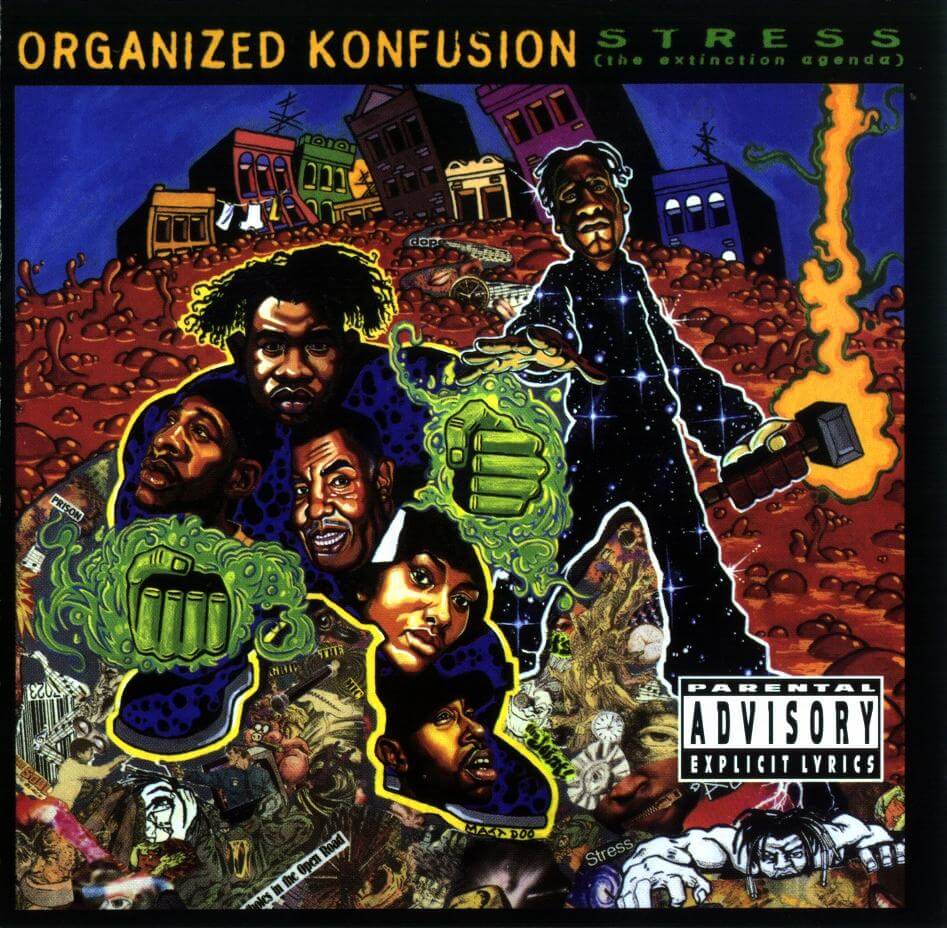
Organized Konfusion had already announced themselves as exceptional lyricists with their self-titled debut, but Stress: The Extinction Agenda takes the duo’s approach into considerably darker territory. Pharoahe Monch and Prince Po sound more urgent, more confrontational, and increasingly adventurous in their writing. The album is steeped in urban anxiety, with the two MCs examining violence, paranoia, social pressure, and everyday survival through intricate rhyme schemes and vivid storytelling.
The title track sets the tone immediately. Buckwild’s production is ominous and unsettling, providing the perfect backdrop for Monch and Po’s descriptions of mounting pressure and frustration. Their verses are packed with internal rhymes, unexpected rhythmic shifts, and densely connected thoughts, but the technical complexity never obscures the urgency of the performances. The same goes for “The Extinction Agenda”, where the pair push their verbal interplay to extraordinary levels. They constantly change direction, stretch syllables, and switch flows, creating a sense of restless energy that runs throughout the record.
“Stray Bullet” is the album’s centrepiece and one of the most inventive pieces of storytelling in 1990s Hip Hop. Monch adopts the perspective of a bullet, following its path through a sequence of events that ends in tragedy. The concept gives the subject of gun violence an unsettling immediacy, with the narrative doing the work rather than relying on a straightforward lecture. “Black Sunday”, “Bring It On”, and “3-2-1” offer further demonstrations of the duo’s technical command, while “Let’s Organize”, featuring O.C. and Q-Tip, brings together four distinctive voices over a more accessible groove.
The production is integral to the album’s atmosphere. Organized Konfusion handle much of the work themselves, with additional contributions from Buckwild and Rockwilder. Jazz fragments, heavy drums, distorted textures, and ominous basslines give the music a claustrophobic edge. The beats rarely offer much comfort, reinforcing the tension in the lyrics and performances.
In a year crowded with outstanding Hip Hop releases, Stress: The Extinction Agenda deserves a place among the very best. Its combination of technical ingenuity, imaginative concepts, and uncompromising atmosphere is extraordinary. For us, this is Organized Konfusion and Pharoahe Monch’s masterpiece, and one of the greatest underground Hip Hop albums ever made. 9/10