

Eric B. & Rakim changed the expectations for rap lyricism. When the Long Island duo emerged in 1986, most MCs relied on straightforward rhyme schemes, crowd-pleasing routines, and forceful delivery. Rakim approached the microphone differently. His internal rhymes, intricate patterns, unexpected rhythmic shifts, and remarkably relaxed cadence gave rap writing a new level of sophistication. Eric B. supplied the DJ presence and musical framework, drawing on funk and soul records to create a sound that suited his partner’s distinctive approach.
Their debut single, “Eric B. Is President,” backed with “My Melody,” announced an extraordinary partnership. Built around the bassline from Fonda Rae’s “Over Like a Fat Rat,” the record introduced a combination of hard-hitting production and unconventional lyricism that immediately attracted attention. Paid in Full followed in 1987, delivering a run of tracks that would become fundamental to Hip Hop’s development. “I Ain’t No Joke,” “My Melody,” “I Know You Got Soul,” and the title track paired Rakim’s controlled delivery with Eric B.’s inventive use of samples, scratches, and funk breaks. The album gave aspiring MCs a new standard for writing and recording.
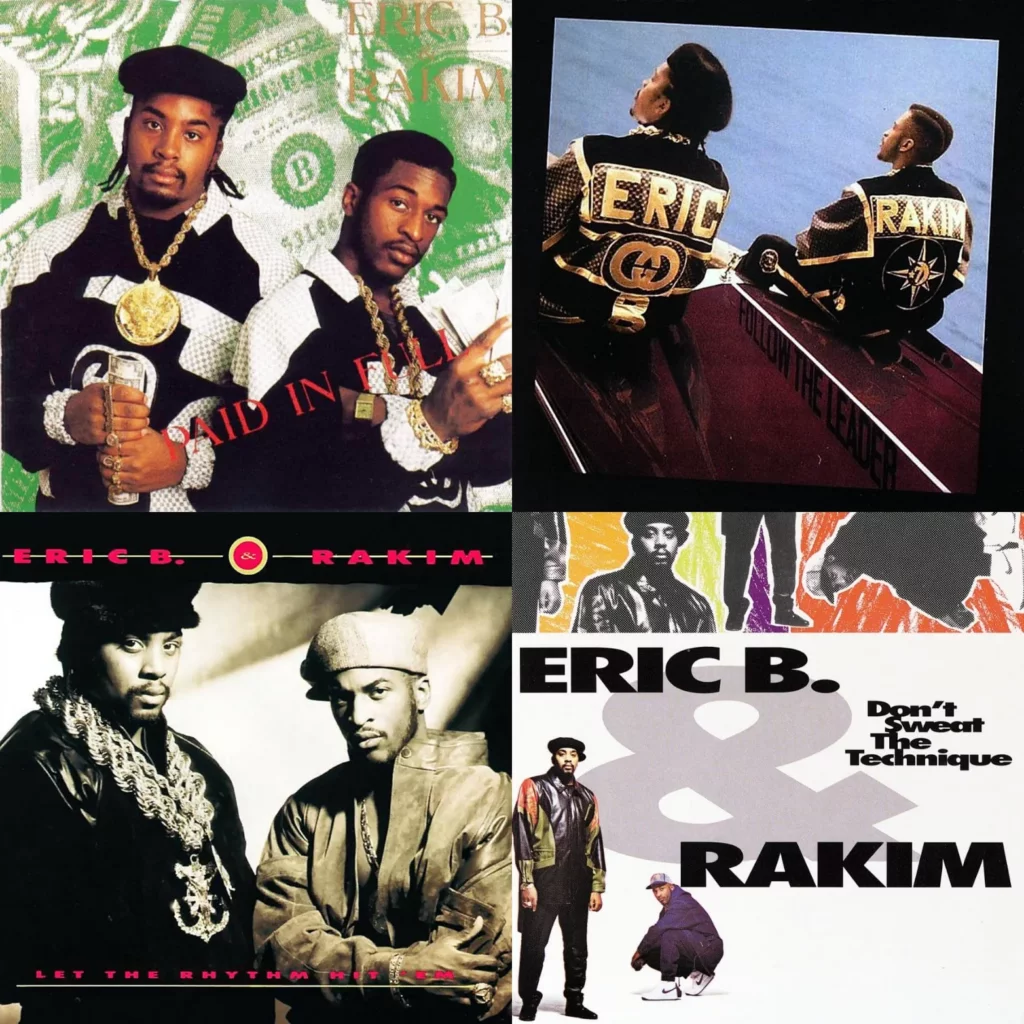
The duo refused to settle into a formula. Follow the Leader (1988) expanded their musical palette while giving Rakim room for some of his most celebrated performances, particularly on the title track and “Lyrics of Fury.” Let the Rhythm Hit ‘Em (1990) took a heavier, darker direction, with tougher beats and a more imposing atmosphere. Their final album together, Don’t Sweat the Technique (1992), incorporated jazzier textures and sharper percussion, producing standouts such as “What’s on Your Mind,” “Know the Ledge,” and the title track.
Questions surrounding Eric B.’s precise production contributions have complicated the story of their partnership. Marley Marl, Large Professor, and the late Paul C. were among the musicians and producers associated with the duo’s recordings, and the official credits do not always tell the complete story. Whatever the division of labor, the records brought together distinctive musical ideas and one of rap’s most influential voices.
Four studio albums, released across six years, trace a remarkable period of artistic development. Paid in Full may be the obvious starting point, but the albums that followed deserve close attention in their own right. Here is our ranking of Eric B. & Rakim’s complete studio album catalogue.
4. Don’t Sweat The Technique (1992)

Don’t Sweat The Technique is arguably the most underappreciated album in Eric B. & Rakim’s catalogue. Their fourth and final studio collaboration finds the duo making another subtle shift in direction, with denser jazz textures, harder drums, and more varied rhythms replacing some of the stripped-down funk that characterized their earlier work. The chemistry is still there, though, and Rakim is operating at an extraordinary level. His intricate rhyme patterns, effortless rhythmic control, and command of language remain intact, while his writing takes in a broader range of social and political subjects.
The title track is an immediate highlight. Its infectious jazz loop, built around Young-Holt Unlimited’s “Queen of the Nile,” and crisp percussion provide an ideal setting for Rakim’s confident delivery. He sounds completely at ease, constructing elaborate rhyme patterns without disrupting the track’s momentum. “Know The Ledge,” originally recorded for the Juice soundtrack, is another standout. Rakim adopts the perspective of a young street hustler whose choices lead to a tragic outcome, building a gripping first-person narrative through economical details and carefully controlled storytelling. “The Punisher” offers a more direct display of his lyrical technique, while “Pass the Hand Grenade” brings back the battle-ready attitude of his earlier material.
There is a darker dimension to much of the album. “Casualties of War” examines the Gulf War from the perspective of a soldier confronting violence, trauma, and the psychological consequences of combat. The unsettling imagery and tense instrumental give the track a particularly disturbing atmosphere. “What’s Going On” addresses the crack epidemic, poverty, police brutality, and violence in Black communities, while “Teach The Children” turns its attention to the circumstances facing younger generations. Rakim handles these subjects without compromising his intricate writing, and Eric B.’s jazz-inflected production gives the material an appropriately heavy backdrop.
The smoother “What’s on Your Mind” provides a different mood, with a relaxed, jazzy arrangement accompanying Rakim’s account of romantic pursuit. Its warmth offers welcome variation within an otherwise serious record.
Four albums, four classics. Don’t Sweat The Technique may lack the immediate impact of Paid in Full and Follow the Leader, but its musical sophistication, lyrical depth, and remarkably consistent execution make it a fitting final statement from one of Hip Hop’s greatest partnerships. | 8/10
3. Let The Rhythm Hit 'Em (1990)
By 1990, Eric B. & Rakim had already changed the standards for rap lyricism. Their third album finds them refining their established formula while moving towards a darker, more varied production approach. Rakim’s measured delivery and intricate rhyme patterns are still the main attraction, but Let The Rhythm Hit ‘Em benefits considerably from the contributions of Paul C and Large Professor, whose work gives the record a tougher, more atmospheric character.
Paul C, whose work on the album preceded his tragic death, provided much of its hard-edged musical foundation. Large Professor helped complete the project, bringing his emerging jazz-influenced production sensibility to several tracks. The combination produces a compelling mixture of stripped-down drum patterns, atmospheric samples, and heavy grooves. There is less of the immediate funk-driven appeal of Paid in Full, with the emphasis shifting towards mood, texture, and rhythmic force.
The title track gets things moving with ominous production and a commanding Rakim performance. His controlled delivery makes even the densest rhyme patterns sound effortless, while the dark instrumental gives his words plenty of room to land. “No Omega” is another lyrical highlight, driven by the break from James Brown’s “Funky Drummer.” Rakim uses the track to demonstrate his remarkable rhythmic precision, constructing intricate verses without sacrificing clarity or momentum. Few MCs have ever made such demanding writing sound so natural.
“In the Ghetto” offers a change of perspective. Over Large Professor’s subdued, almost haunting production, Rakim turns his attention to the harsh realities of life in disadvantaged neighborhoods. His observations are direct and thoughtful, avoiding the melodrama that often accompanies socially conscious rap. The track also demonstrates how effectively his understated delivery works outside the battle-rap format. “Eric B. Made My Day,” meanwhile, shifts the focus towards Eric B.’s scratching, recalling the DJ-centered foundations of the duo’s earlier work.
The album occasionally lacks the immediate impact of its predecessors, but its more serious atmosphere gives it a distinct identity. Rakim is in formidable form throughout, while Paul C and Large Professor provide some of the strongest musical foundations in the duo’s catalogue. Let The Rhythm Hit ‘Em captures a partnership continuing to develop after already changing the direction of Hip Hop. | 8.5/10
2. Follow The Leader (1988)

With Follow The Leader, Eric B. & Rakim faced the difficult task of following a debut that had already changed the direction of Hip Hop. Their response was an ambitious, assured album that expanded the musical foundations of Paid in Full while giving Rakim even more room to explore his writing. Eric B. moved beyond the relatively stripped-down funk loops of the first record, introducing richer arrangements, different textures, and a more varied production palette. Rakim, meanwhile, sounded increasingly comfortable with the possibilities of his own technique.
The title track immediately establishes a different kind of momentum. Its rolling groove and atmospheric production provide the backdrop for Rakim’s intricate rhymes, delivered with the same unhurried confidence that made his debut so distinctive. He shifts cadences, places internal rhymes in unexpected spaces, and moves between lyrical boasts and more abstract imagery without disturbing the track’s flow. “Microphone Fiend” takes his obsession with MCing as its subject, comparing the need to rhyme to an addict’s dependence on a substance. The concept gives Rakim plenty of opportunities for inventive wordplay, while the bass-heavy production keeps the track moving with an irresistible groove.
Then comes “Lyrics of Fury,” arguably the album’s most astonishing performance. Rakim abandons some of his usual restraint, attacking the beat with unusual urgency and filling his verses with dense internal rhymes, elaborate patterns, and vivid imagery. The relentless James Brown-derived percussion provides an appropriately explosive foundation. The contrast between this intensity and his more measured performances elsewhere makes the track especially effective. Few recordings capture his technical command quite so convincingly.
There is considerably more to the album than its celebrated lyrical performances. “Put Your Hands Together” introduces a communal energy, while “To the Listeners” addresses the audience directly. Instrumental cuts such as “Eric B. Never Scared” and “Beats for the Listeners” give Eric B. room to emphasize his turntable skills, recalling the DJ-centered foundations of the duo’s music. “Musical Massacre” takes things in a darker direction, adding another dimension to the album’s varied production.
Follow The Leader never needed to replicate Paid in Full. Instead, Eric B. & Rakim delivered a more expansive record, with increasingly sophisticated production supporting some of Rakim’s finest writing. Two albums into their partnership, they were already operating at an extraordinary level. | 9/10
1. Paid In Full (1987)

The opening bars of “I Ain’t No Joke” make clear that Eric B. & Rakim are operating on a different level. Rakim’s voice is calm, almost conversational, but the writing is anything but ordinary. Internal rhymes, intricate patterns, unexpected rhythmic turns, and a remarkable command of phrasing give every verse a precision that was rare in rap at the time. He doesn’t need to shout or crowd the beat. His measured delivery draws attention to the words themselves, making even the most complex passages sound effortless. With Paid In Full, the art of MCing took a significant leap forward.
The production gives Rakim room to work. The arrangements are spacious and built around hard drum breaks, funk samples, basslines, and sharp cuts. There is an economy to the beats that suits the rapper’s controlled approach, while Eric B.’s turntable work keeps the music connected to Hip Hop’s DJ-centered foundations. The Marley Marl-produced “Eric B. Is President” and “My Melody” announce the partnership with authority, combining rugged rhythms with a new level of lyrical sophistication. “I Know You Got Soul,” driven by its unmistakable James Brown sample, brings an infectious funk energy, while “Move the Crowd” finds Rakim demonstrating just how much rhythmic variation he can draw from a single groove.
The title track is another defining moment. Its hypnotic bassline and sparse percussion give Rakim space to reflect on ambition, money, and the rewards of his craft. The Coldcut remix would later introduce the song to a much wider audience in Europe, but the original recording needs little embellishment. Across the album, “I Ain’t No Joke,” “I Know You Got Soul,” and “Paid in Full” form an extraordinary run, while the remaining tracks reinforce the sense of a duo working with a clear musical identity.
The album does have some uneven stretches. The instrumental versions interrupt the flow, and the second half doesn’t quite sustain the intensity of the opening sequence. Those reservations barely diminish the achievement. Paid In Full gave subsequent generations of MCs a new vocabulary for approaching rhyme, cadence, and lyrical construction. Its influence can be heard in the work of Nas, Kool G Rap, and countless others, but the original recordings still have their own unmistakable authority. Nearly four decades later, Rakim’s performances remain astonishing, and Eric B.’s stripped-down funk production has lost none of its appeal. | 9.5/10