

OutKast didn’t need to leave Atlanta to change the direction of Hip Hop. André 3000 and Big Boi emerged from the city’s Dungeon Family scene with a distinctly Southern perspective at a time when the genre was still too often measured against New York and Los Angeles. Their debut, Southernplayalisticadillacmuzik (1994), made an immediate case for Atlanta. Rooted in warm bass lines, loose funk, and live-sounding grooves, the record captured Southern street life with humor, detail, and a strong sense of place. “Player’s Ball” had already introduced the duo to a wider audience, and the album announced two MCs with an unmistakable chemistry and a sound of their own.
OutKast never settled into one formula. ATLiens (1996) replaced much of the debut’s easygoing funk with murkier production and a more introspective outlook. On Aquemini (1998), André and Big Boi sharpened the contrast between their approaches, combining intricate lyricism with an expansive musical palette that drew on funk, soul, gospel, and psychedelia. The results were among the most ambitious and accomplished recordings of their era. Stankonia (2000) pushed the experimentation into even less predictable territory. The frantic energy of “B.O.B. (Bombs Over Baghdad),” the effortless funk of “So Fresh, So Clean,” and the emotional complexity of “Ms. Jackson” all came from a group comfortable taking risks without losing its instinct for memorable songs.
Their next move was arguably their boldest. Speakerboxxx/The Love Below (2003) split the double album into two distinct solo statements. Big Boi delivered tightly constructed Southern rap on Speakerboxxx, while André explored funk, pop, soul, and live instrumentation on The Love Below. The commercial success of “The Way You Move” and “Hey Ya!” brought OutKast to an even wider audience, and the album won the Grammy for Album of the Year. Their final studio release as a duo, Idlewild (2006), took another detour, drawing on musical theater and period styles for its soundtrack to the film of the same name.
Across six albums, OutKast maintained a rare balance between technical skill, musical curiosity, and a strong regional identity. Big Boi’s precision and rhythmic command complemented André’s unpredictable writing and restless creativity. Their paths eventually diverged, and a 2014 reunion tour did not lead to another studio album.
Our ranking looks at all six releases, weighing their musical quality, consistency, originality, and lasting impact. OutKast’s catalog is remarkably varied, and deciding which records deserve the highest positions means looking beyond commercial success to what each album achieves on its own terms.

6. Idlewild (2006)

Idlewild is often treated as the weakest entry in OutKast’s catalog, but that assessment overlooks how much ambition went into the project. Conceived as a companion to the duo’s musical film of the same name, the album takes the stylistic freedom of Speakerboxxx/The Love Below in a different direction. Its musical world draws heavily on big-band jazz, swing, blues, and soul, filtering those older traditions through contemporary Hip Hop. The result is an unusual record that occasionally loses its focus, but has a personality few other rap albums from the period could match.
The strongest tracks make the concept work. “Morris Brown,” featuring Sleepy Brown and Scar, brings marching-band brass and Southern rap together in an exuberant performance. André 3000’s “Idlewild Blue (Don’tchu Worry ‘Bout Me)” takes a different route, leaning into acoustic blues and a relaxed vocal delivery that suits the song’s vintage influences. Big Boi reconnects with the group’s earlier Atlanta sound on “The Train,” a lively track that balances familiar Southern grooves with the album’s period aesthetic. “Hollywood Divorce,” featuring Lil Wayne and Snoop Dogg, shifts back toward contemporary Hip Hop, with André’s production giving the collaboration its own character. “Mighty ‘O'” and “Life Is Like a Musical” also contribute to the record’s theatrical atmosphere, while “Call the Law” brings Janelle Monáe into the mix for a particularly engaging encounter.
The division between the two MCs is especially noticeable here. Big Boi tends to stay closer to the rhythmic precision and grounded rap style that have always anchored OutKast, while André spends much of the album exploring singing, blues, and theatrical performance. That creative split gives Idlewild some of its most interesting moments, although the collection can feel more like a series of experiments than a fully unified album. At nearly 78 minutes, it also has stretches that dilute the impact of its best material.
Still, the musical imagination on display deserves more appreciation. Idlewild is an uneven final chapter, but its adventurous approach and distinctive atmosphere make it considerably more rewarding than its reputation suggests. Calling it OutKast’s weakest album says as much about the extraordinary standard of the five records preceding it as it does about this one. | 7/10
5. Speakerboxx/The Love Below (2003)

Few groups would have attempted a double album as audacious as Speakerboxxx/The Love Below. Rather than trying to make two complementary halves of one conventional OutKast record, André 3000 and Big Boi each took the opportunity to pursue their own musical vision. The result is a fascinating split between two artists who had always brought different strengths to the group, now given an entire album apiece to explore them. It became OutKast’s biggest commercial success, selling millions of copies worldwide and taking home the Grammy for Album of the Year.
Big Boi’s Speakerboxxx is the more recognizably Hip Hop half, although traditional hardly describes its range. His Southern rap foundations are mixed with P-Funk, electronic textures, gospel, and big-band arrangements. “GhettoMusick” opens with an abrasive burst of energy, while “Bowtie” is an irresistible funk workout. “The Way You Move,” with Sleepy Brown, pairs Big Boi’s nimble verses with a smooth, infectious hook. Elsewhere, “Unhappy,” “War,” and “Church” reveal the ambition of his writing, addressing personal, political, and spiritual concerns without sacrificing the record’s musical momentum. His technical command and rhythmic precision are impressive throughout.
André’s The Love Below ventures much further from conventional rap. Drawing heavily on Prince, funk, jazz, psychedelic soul, and pop, it is an eccentric collection built around singing, unconventional arrangements, and a succession of different musical personalities. “She Lives in My Lap” and “Prototype” explore romantic longing from very different angles, while “Roses” brings Big Boi back into the picture for one of the album’s sharpest moments. Then there’s “Hey Ya!”, an irresistible pop-funk explosion whose infectious energy disguises a more troubled view of relationships. André’s willingness to follow his ideas wherever they lead gives this half its distinctive character.
At over two hours, the double album is sprawling, and the two halves don’t always feel like parts of the same project. That separation, however, is central to its appeal. Speakerboxxx/The Love Below captures two exceptionally gifted artists at a point when neither was interested in playing it safe. Its ambition, musical diversity, and sheer number of memorable songs make it one of the most remarkable releases in OutKast’s catalog. | 7.5/20
4. Stankonia (2000)

Thick with funk, restless energy, and an almost mischievous sense of experimentation, Stankonia finds OutKast taking another major leap after Aquemini. The duo had built their own recording facility in Atlanta, giving them the freedom to work without the usual studio time constraints. They used that freedom to create a faster, more unpredictable record, drawing on Parliament-Funkadelic, Prince, Jimi Hendrix, gospel, psychedelia, and electronic music. Earthtone III, the production team formed by André 3000, Big Boi, and Mr. DJ, took a leading role alongside Organized Noize. The result is unmistakably Southern Hip Hop, though its musical vocabulary reaches well beyond familiar regional conventions.
“B.O.B. (Bombs Over Baghdad)” is the most spectacular example of this approach. Driven by frantic drum ‘n’ bass rhythms, distorted guitars, organs, and gospel vocals, it pushes André and Big Boi into breathless performances that match the track’s extraordinary pace. “Gasoline Dreams” opens with a similarly abrasive charge, taking aim at the materialism and social problems surrounding contemporary Black culture. At the other end of the spectrum, “So Fresh, So Clean” glides on a smooth, hypnotic groove, while “Ms. Jackson” turns a deeply personal subject into one of the duo’s most accessible and affecting songs. Its combination of melodic warmth and candid emotion gave OutKast their first number-one single on the Billboard Hot 100.
The album’s deeper cuts are equally revealing. “Humble Mumble,” featuring Erykah Badu, combines salsa-influenced rhythms with sharp observations about Hip Hop and the assumptions surrounding it. “Snappin’ & Trappin'” introduces Killer Mike, whose commanding performance holds its own alongside the two headliners. “Red Velvet” aims materialism within the rap industry, while “Toilet Tisha” approaches a difficult subject with empathy. Throughout the record, André’s increasing use of melodic singing adds another dimension to the group’s already distinctive chemistry. Big Boi keeps the rap foundation firm with his precision, wit, and commanding delivery.
For all its stylistic range, Stankonia never loses its sense of fun. The music is exuberant, occasionally strange, and packed with ideas, but the hooks and grooves are strong enough to make the experimentation inviting. OutKast had already made two exceptional albums, and this one took their creative ambition to another level without sacrificing the Southern funk at the heart of their identity. | 8.5/20
3. Southernplayalisticadillacmuzik (1994)

OutKast arrived with a clear sense of where they came from and something to prove. André 3000 and Big Boi were still teenagers when they recorded Southernplayalisticadillacmuzik, drawing on the Southern rap traditions of UGK, Geto Boys, and Eightball & MJG while giving Atlanta a distinctive musical identity. Produced entirely by Organized Noize, the album blends programmed drums and deep 808 bass with live guitar, keyboards, organ, and rich soul vocals. Its relaxed grooves and warm funk arrangements gave Southern Hip Hop a character that couldn’t be mistaken for New York boom-bap or West Coast G-funk.
The chemistry between the two MCs was already impressive. Big Boi brought a nimble, rapid-fire delivery and a sharp eye for street-level detail, while André favored a looser cadence, inventive phrasing, and occasional melodic touches. Their lyrics revolve around growing up in Atlanta, player culture, cars, hustling, and everyday neighborhood life, with humor and Southern slang woven throughout. The title track, “Ain’t No Thang,” and “Hootie Hoo” capture the album’s laid-back confidence, while “Player’s Ball” introduced the duo to a much wider audience. The Organized Noize production gives these songs an organic feel, with bass lines and instrumental details that make the grooves particularly distinctive.
There is a more reflective side to the record, too. “Git Up, Git Out,” featuring Goodie Mob, urges young listeners to pursue their ambitions rather than waste their lives, while “Crumblin’ Erb” addresses violence within the Black community and its destructive consequences. These tracks reveal a maturity that contrasts with the youthful bravado elsewhere. The Dungeon Family’s presence also gives the album a strong sense of collective identity, with Atlanta’s emerging creative community contributing to its character.
OutKast’s appearance at the 1995 Source Awards became a defining moment. After winning Best New Rap Group and facing a hostile reception, André famously declared, “The South got something to say.” Southernplayalisticadillacmuzik had already made that argument. Its platinum success helped open the door for Atlanta’s next generation and gave Southern artists a stronger position in a Hip Hop industry dominated by the coasts. OutKast would make even more adventurous albums, but their debut laid the foundation for everything that followed. | 8.5/10
2. ATLiens (1996)
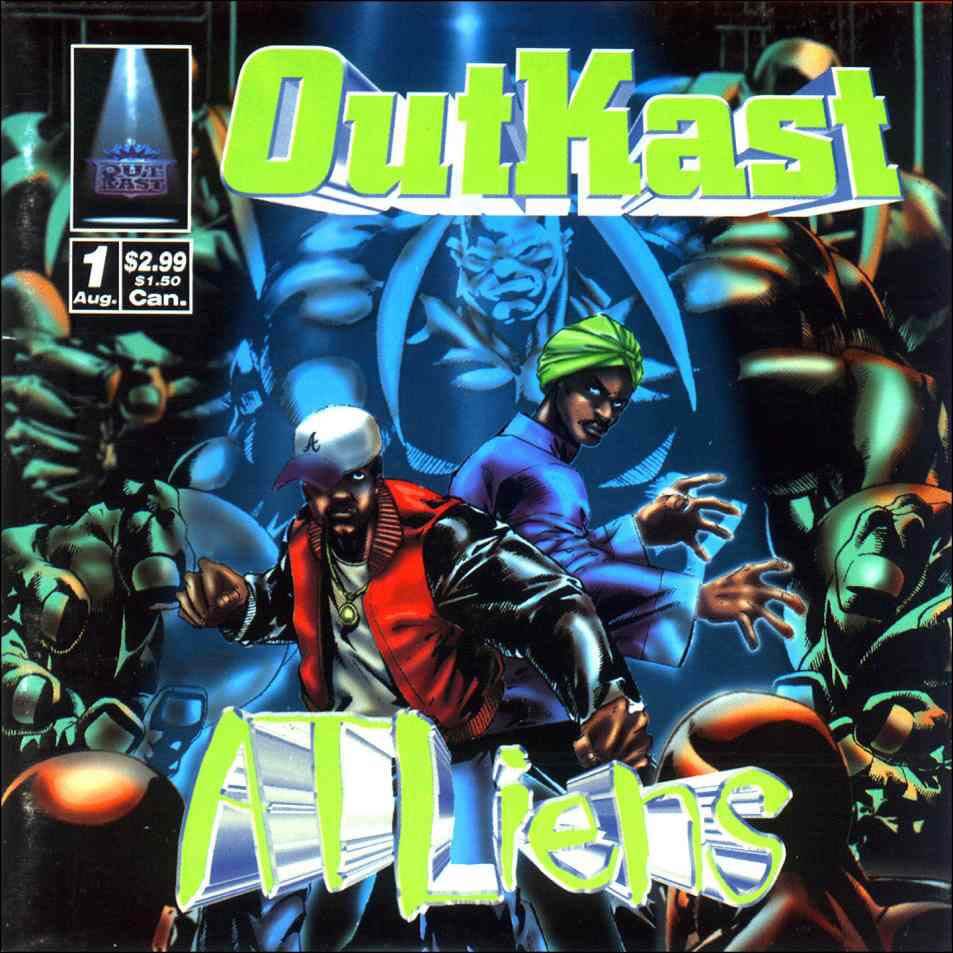
Following the success of Southernplayalisticadillacmuzik, OutKast faced the challenge of making a second album that could match their debut without repeating it. ATLiens answered that challenge by taking a different path. André 3000 and Big Boi moved away from the easygoing player characters of their first record, turning inward to explore adulthood, spirituality, social pressures, and the complications of sudden fame. The title combines Atlanta’s abbreviation, ATL, with “aliens,” reflecting their outsider status in a Hip Hop culture still reluctant to recognize the South as an equal creative force.
Organized Noize provides most of the production, replacing much of the debut’s live funk with a more spacious, atmospheric approach. Deep bass lines, echoing percussion, gospel harmonies, and hazy keyboards give the music a distinctly futuristic character, with dub and reggae influences adding to its hypnotic quality. OutKast also began taking control behind the boards, producing several tracks themselves. “Elevators (Me & You)” is the clearest indication of their growing confidence as producers, its understated groove providing the backdrop for a thoughtful account of fame, changing relationships, and the unlikely rise of two Atlanta teenagers. The title track balances its cosmic atmosphere with a proud declaration of Southern identity, while “Wheelz of Steel” brings Mr. DJ’s impressive turntable work into the mix.
The writing is just as compelling. On “Jazzy Belle,” André and Big Boi reflect on their changing attitudes toward women, while “Babylon” examines the tension between religious upbringing and sexual desire. “Mainstream,” featuring Goodie Mob’s T-Mo and Khujo, questions the compromises involved in commercial success. “E.T. (Extraterrestrial)” takes the album’s otherworldly concept into more experimental territory, and the closing “13th Floor / Growing Old” combines Big Rube’s spoken introduction, Debra Killings’ soulful vocals, and a beautiful piano arrangement for a meditation on aging and mortality.
ATLiens is OutKast’s most cohesive album, with a carefully sustained atmosphere and a remarkable balance between introspection and groove. It reached number two on the Billboard 200 and eventually went double platinum, confirming that the duo’s new direction had found a large audience. Three decades later, its combination of Southern identity, thoughtful writing, and adventurous production still sounds distinctive. OutKast had found their own universe, and they were entirely comfortable operating outside everybody else’s expectations. | 9/10
1. Aquemini (1998)
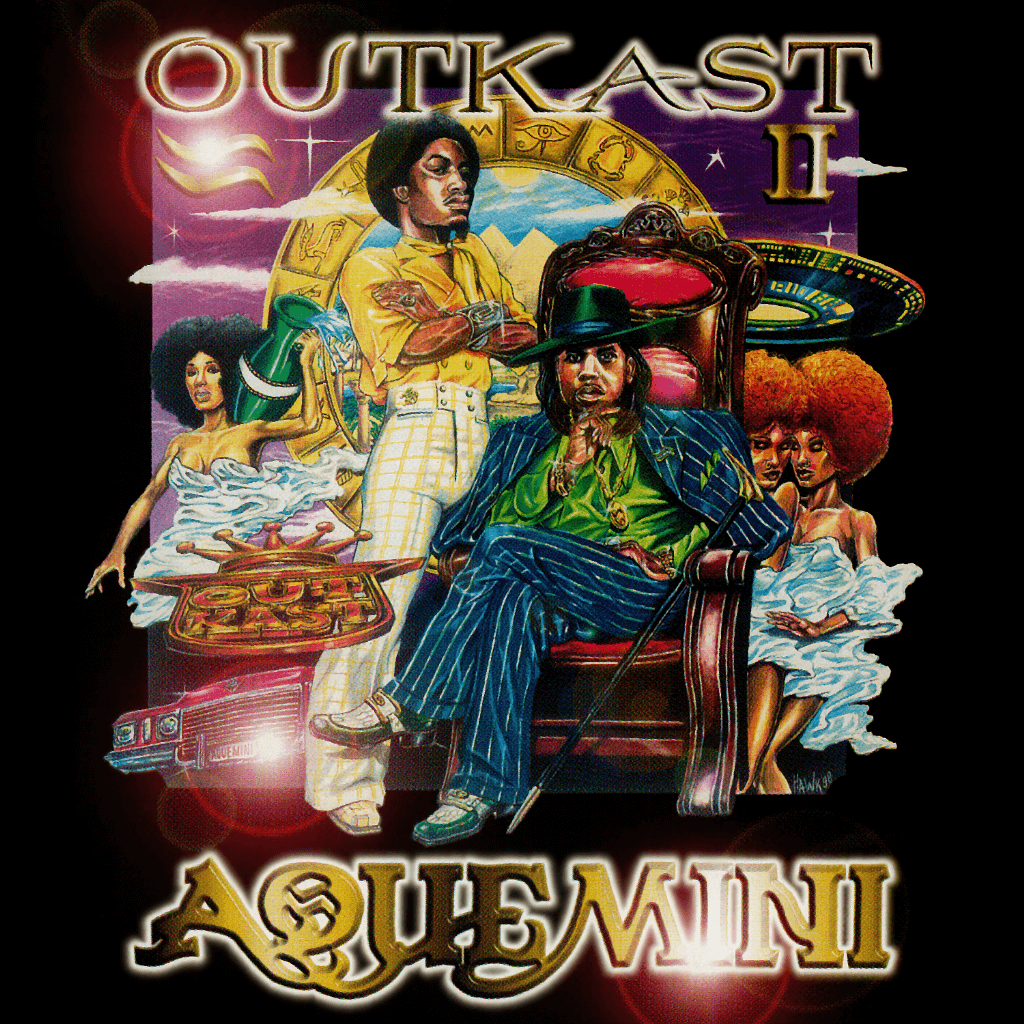
With Aquemini, OutKast reached a level of artistic freedom that few Hip Hop groups have ever matched. Their third album brings together the Southern funk of Southernplayalisticadillacmuzik and the atmospheric qualities of ATLiens, then takes those foundations into a much wider musical territory. Live instrumentation, psychedelic rock, gospel, soul, country, and electronic textures all find their place here. The arrangements are rich and unpredictable, yet the album has a remarkable sense of cohesion. André 3000 and Big Boi were now taking greater control of the production, working alongside Organized Noize and a rotating cast of musicians to create something that sounds organic, ambitious, and unmistakably their own.
The album’s title combines the duo’s zodiac signs, Aquarius and Gemini, reflecting the differences that have always defined their partnership. Big Boi brings rhythmic precision, streetwise observations, and an instinct for memorable hooks. André ventures into philosophical reflection, surreal imagery, and unconventional storytelling. “Return of the ‘G'” addresses criticism of the group’s changing image and musical direction, while “Rosa Parks” turns a blues-inflected Southern groove into an exuberant rap performance. “Skew It on the Bar-B,” featuring Raekwon, connects Atlanta’s perspective with New York’s mafioso rap tradition. George Clinton’s appearance on the futuristic “Synthesizer” adds another dimension to the album’s already expansive musical palette.
Some of its finest moments unfold at a more leisurely pace. “SpottieOttieDopaliscious” is a remarkable seven-minute story of attraction and romantic disappointment, built around an unforgettable horn arrangement and spoken-word performances from André and Big Boi. “Da Art of Storytellin’ (Part 1)” delivers a deeply affecting narrative about a childhood friend whose life ends in tragedy. Its apocalyptic sequel takes the story in a completely different direction. “West Savannah” pays tribute to Big Boi’s Southern roots, while the eight-minute “Liberation,” featuring Cee-Lo and Erykah Badu, moves through gospel, jazz, blues, and spoken word without a conventional rap verse. The closing “Chonkyfire” brings the record to a turbulent finish, with distorted guitars and fragments of the duo’s famous 1995 Source Awards speech.
Aquemini is an extraordinary achievement because its musical ambition never comes at the expense of its human perspective. Its reflections on friendship, individuality, addiction, relationships, and Southern identity give the experimentation genuine weight. The album also points toward the kind of expansive, culturally grounded Hip Hop later explored by artists such as Kendrick Lamar on To Pimp a Butterfly. OutKast had already made two exceptional records, but this was the moment when their individual talents and shared vision came together most completely. Few groups in Hip Hop history have created a body of work this varied, and Aquemini is its crowning achievement. | 9/10