

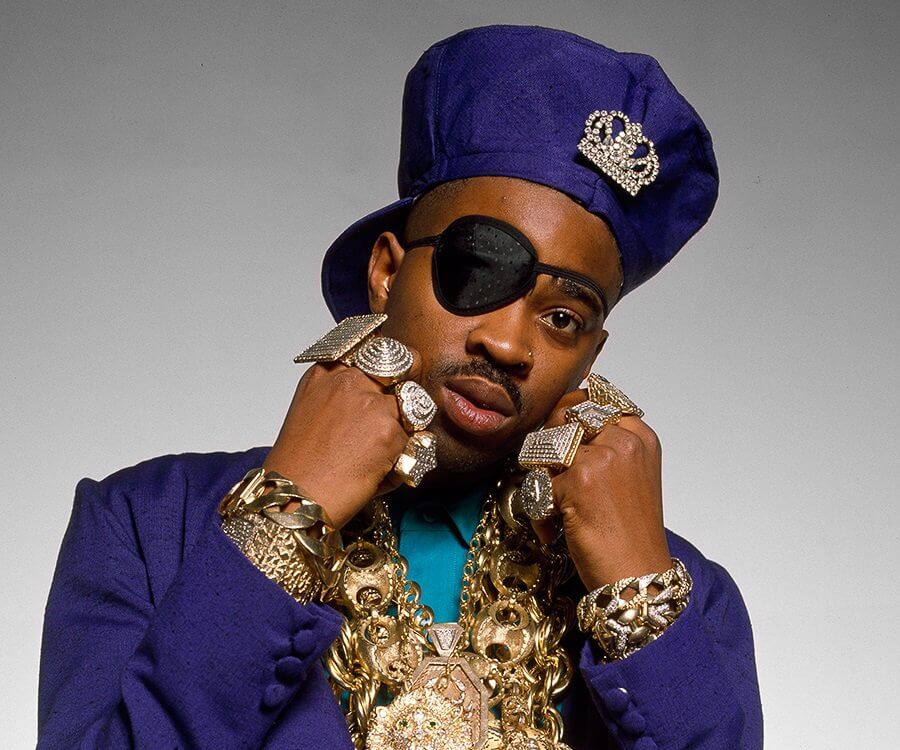
With an eye patch, a British accent, and a voice like silk dipped in swagger, Slick Rick brought theater to Hip Hop. Born Ricky Martin Lloyd Walters in London and raised in the Bronx, he built his early name in the 1980s with the Kangol Crew and then exploded into wider view alongside Doug E. Fresh on the 1985 classics “La Di Da Di” and “The Show”. But it was The Great Adventures of Slick Rick, his 1988 solo debut on Def Jam, that made it clear: nobody told stories like The Ruler.
Rick’s style hit different. Where others roared, he narrated. His flow curved through tales with a sly calm, as if he was whispering secrets across the block. “Children’s Story” laid out a full-blown crime narrative over a beat that never broke a sweat. “Mona Lisa” flirted through a museum scene with bounce and bite. “Teenage Love” dialed it down into something tender, without losing any edge. His storytelling didn’t lean on intensity—he let rhythm and tone do the lifting, balancing mischief, wisdom, and a hint of melancholy in every bar.
Just as his career reached its height, Rick’s life spun sideways. A self-defense shooting in 1990—where a bystander caught a bullet—led to legal trouble, prison time, and immigration problems that shadowed him for years. Even behind bars, he kept writing. The Ruler’s Back and Behind Bars pulled verses from turmoil without losing that polished swing in his voice. Cuts like “I Shouldn’t Have Done It” kept his humor sharp, while the title track from Behind Bars framed confinement in tight rhyme schemes and smooth, bouncing production.
Slick Rick didn’t rely on gimmicks or production tricks to hold a track. He built songs like short films—clear, stylish, and unforgettable. His influence runs wide: from fashion to cadence, from story arcs to slang. Artists like Snoop Dogg, Ghostface Killah, and Nas have all borrowed something from Rick’s way of building verses that feel lived-in.
This list of the Top 15 Slick Rick songs digs into the cuts where his voice, wit, and storytelling hit hardest. The ones that shaped how Hip Hop could narrate, reflect, and entertain. Whether you’re revisiting old favorites or discovering him for the first time, these tracks still slide like they were made yesterday.
Also read: Essential Rap Songs: Top 15 Lists For Every Influential Hip Hop Act
15. King (1991)
“Is there a party over here, wit no guns and knives gettin in / Now let and best, get sweat the life threatenin’…”
“King” is a confident display of Slick Rick’s unmatched flow and charisma from The Ruler’s Back. The track’s bold, in-your-face energy is all about Rick asserting his place at the top, with a flow that’s effortlessly smooth yet commanding. His clever wordplay and vivid storytelling are in full effect as he rhymes about his power and influence. The production, complete with slick scratches and infectious beats, complements Rick’s self-assured delivery. Though his sophomore album doesn’t always get the recognition it deserves, “King” stands out as a clear reminder of Slick Rick’s lyrical dominance.
14. Lick The Balls (1988)
“Now everything that come out your mouth, sound like it’s out of spite / I’m back on a mission and this time I’m gonna anchor right / That’s right, ads help, he’s improvin it / “Thank gosh Rick! We love the way you’re movin it” / Who’s hittin rough in eighty-eight I bet your momma knows / Backslap you all down like y’all were dominoes…”
“Lick The Balls” is a standout track from The Great Adventures of Slick Rick, often overlooked despite its memorable presence. Over a hard-hitting Bomb Squad instrumental, Rick delivers a brash and boastful performance that highlights his sharp lyrical skill. While its title may raise eyebrows, the track is a masterclass in braggadocio, a theme that runs through much of Rick’s early work. This track is a reminder of Rick’s versatility, as he balances his more thoughtful storytelling with playful, in-your-face swagger. While it may not carry the same weight as some of his other classics, “Lick The Balls” remains a favorite among fans who appreciate the raw energy and confidence that defined Slick Rick’s debut. It’s a fitting closer to an album packed with diverse styles and themes.
13. Behind Bars (1994)
“In the slammer kid but I’m innocent / Lord played witty wasn’t having any pity / Now in Razor Blade City…”
“Behind Bars” is the title track from Behind Bars, Slick Rick’s third album, and one of its standout moments. Produced by Prince Paul, the song offers a personal narrative that reflects Rick’s time in prison. It’s a deeply introspective track where Rick opens up about the struggles he faced, his thoughts on life, and the impact of his situation. While the album didn’t receive the same praise as his earlier work, “Behind Bars” provides a raw look into Rick’s mind during a turbulent time. The track highlights his ability to blend storytelling with emotional depth, creating a powerful moment that resonates despite the challenges surrounding the album’s release.
12. Mistakes Of A Woman In Love With Other Men (1991)
“Call me the freaker, I bump it in ya speaker / Week on my birthday, met this girl named Tameka / Astonishing creature, made the rest look tired / Desired, that was the beauty I admired…”
“Mistakes of a Woman in Love with Other Men” is a standout track from The Ruler’s Back, offering a reflective look at a woman caught in a turbulent love triangle. Slick Rick’s smooth delivery and knack for storytelling shine as he explores the emotional complexities of infidelity. The song’s mellow, soulful beat complements the narrative, allowing Rick’s lyrical depth to take center stage. Despite the challenges faced by The Ruler’s Back in the shadow of his debut, this track remains one of its most memorable moments. Rick’s ability to capture the intricacies of human emotion, combined with his effortless flow, makes this song a compelling entry in his catalog and a standout on the album.
11. Teenage Love (1988)
“See just when you swore, the ball was rollin’ and / Then they’re gone, and part of ya heart’s been stolen / Get back on your feet, with a hop and a skip / But no, you rather go wit this dead relationship…”
“Teenage Love” serves as the first single from The Great Adventures of Slick Rick and captures the bittersweet experience of first love. With a smooth, reflective tone, Rick explores the emotions of young infatuation, from the excitement to the heartache. The track taps into the growing rap ballad movement, blending storytelling with a melodic hook.
Rick’s delivery is a mix of rapped verses and a sung chorus, a precursor to the sung-rap style that would later dominate hip-hop. The chorus, borrowed from Diana Ross’ “Theme from Mahogany (Do You Know?)”, adds a layer of emotional depth to the track, enhancing its nostalgic feel. “Teenage Love” also earned its place in Hip Hop history through its memorable music video cameos by Big Daddy Kane and a young Lil’ Kim.
10. Memories (1999)
“Fine grown Pine-Sol / Heavenly rhyme throne / Remember when you were young in the ’70 time zone / Stages, ages about seven I say kids / The dress code of our parents looked awfully outrageous / Not down on ’em, games and clownin / When soul was at it’s highest rate like James Brown and them…”
“Memories” from The Art of Storytelling is a nostalgic journey through Slick Rick’s past, set to a smooth beat crafted by DJ Clark Kent. The track captures Rick’s ability to weave rich imagery, reminiscing about his youth with vivid details and a laid-back flow. From references to ’70s culture to personal anecdotes about his early years, Rick brings a sense of warmth and relatability to the track.
The song stands out for its reflective tone, as Rick reminisces about simpler times, highlighting everything from classic TV shows to childhood memories. The lyrics are rich with nostalgia, painting a picture of youth in a world far removed from today’s realities. With “Memories,” Rick continues to showcase his knack for storytelling, blending personal history with universal themes of growth and change.
Though often overshadowed by other tracks on The Art of Storytelling, “Memories” is a standout for its heartfelt lyrics and smooth, soulful production, making it a timeless reflection on life’s simpler pleasures.
9. The Moment I Feared (1988)
“Well I’m sittin on my lunch break, grinnin my teeth / It’s the last day of the week, boy what a relief / My muscles kind of ache, they felt rigid and stiff / So I looked around, and I smoked this big fat spliff / Now I’m happy as can be I’m in this pothead spell / I put some Visine in my eyes so that no one can tell / It’s 12:55 almost time for the bell / Put the breath mints in the mouth so that the mouth don’t smell…”
On “The Moment I Feared,” Slick Rick delivers another standout from The Great Adventures of Slick Rick, displaying his exceptional storytelling prowess. The track paints a vivid picture of the street life, highlighting the dangers and the tension that come with it. Rick weaves a tale of confrontations and escalating drama, all set against the backdrop of the legendary Latin Quarter. His ability to capture the raw, often unpredictable nature of life on the streets remains a defining feature of his style.
The song’s narrative unfolds with cinematic detail, offering listeners a front-row seat to the tension and conflict that ultimately lead to a life-changing moment. With its smooth flow and immersive storytelling, “The Moment I Feared” is a prime example of Rick’s unmatched skill at crafting cautionary tales.
8. Street Talkin' ft. Big Boi (1999)
“OutKast and Slick, the answer is in it / Hon you need to get your ass on the dancefloor this minute…”
On “Street Talkin’,” Slick Rick teams up with OutKast’s Big Boi for a smooth collaboration that marks his return after a five-year hiatus. Rick’s laid-back flow pairs perfectly with Big Boi’s rapid-fire delivery, creating a dynamic contrast. Their chemistry, first sparked on “Da Art of Storytellin’ (Pt. 1),” shines as they trade verses about street life and survival, weaving street-smart insights with sharp storytelling.
Released as the lead single from The Art of Storytelling, “Street Talkin’” finds Rick sounding revitalized, blending his classic style with a modern twist. Big Boi’s Southern flair complements Rick’s effortless delivery, making the track a standout on the album.
“Street Talkin’” highlights Rick’s continued ability to captivate with his storytelling while staying connected to the evolving sound of hip-hop. It’s a track that reinforces his place in the genre, balancing his iconic voice with fresh energy.
7. The Ruler's Back (1988)
“Gather ’round party goers as if your still livin / And get on down to the old Slick rhythm / Now this one here is called the Ruler my dear / It’s a mere party booster that will set things clear / It’s a hundred percent proof from champions of truth / And if you feel you need spirit I’ll bring back your youth / Relax your mind, and folks unwind / And be kind to a rhythm that you hardly find / And off we go, let the trumpets blow / Well hold on, because the driver of the mission is a pro… / The Ruler’s back…”
“The Ruler’s Back” opens The Great Adventures of Slick Rick with full fanfare—horns blare, the beat struts, and Rick arrives not just as a rapper, but as a persona. Framed as both introduction and proclamation, the track sets the tone for everything that follows. From the first line, he assumes the throne with ease, lacing his verses with humor, flair, and self-assured charm.
Built around a regal brass loop and sharp drum hits, Jam Master Jay’s production mirrors the energy of a coronation. Rick flows through it with precision, laying out his agenda and style with absolute clarity. It’s all presence—an MC stepping into his moment with no hesitation.
The song originally circulated as an early promo before the album’s release, catching buzz through cassette copies in DJ circles. By the time the LP dropped, “The Ruler’s Back“ already felt like an anthem. Beyond its declarative title, it’s a track that lives up to its promise—celebratory, theatrical, and unmistakably Slick Rick.
6. I Shouldn't Have Done It (1991)
“Well, I’mma tell you a story and I come out bluntly / Born an ugly child; hey, nobody would want me / I used to walk around and get upset and upsetter / Till I figured out ways to make myself look better…”
Released as the lead single from The Ruler’s Back, “I Shouldn’t Have Done It” finds Slick Rick delivering one of his most infectious cautionary tales. Set against a polished, club-ready backdrop produced by Vance Wright, the track blends New Jack Swing-era bounce with Rick’s unmistakable delivery—cool, clipped, and always in control.
Built from a collage of James Brown samples, the beat is kinetic, but the story is full of tension. Rick walks listeners through a moment of weakness, laced with regret and complication. The affair he details unfolds with his usual eye for rhythm and detail, culminating in a closing twist that lands hard without melodrama.
While Rick’s storytelling often leans into fantasy or exaggeration, this one feels more grounded, almost confessional. He narrates the fallout with a kind of detached honesty, letting the beat carry the emotion beneath the surface. The hook is smooth and catchy, a contrast to the escalating situation in the verses.
It’s a track built for the dancefloor, but layered with quiet consequence. That mix of energy and introspection makes I Shouldn’t Have Done It resonate long after the groove fades.
5. Hey Young World (1988)
“This rap here… it may cause concern it’s / Broad and deep… why don’t you listen and learn / Love mean happiness… that once was strong / But due to society… even that’s turned wrong / Times have changed… and it’s cool to look bummy / And be a dumb dummy and disrespect your mummy…”
Released as the third single from The Great Adventures of Slick Rick, Hey Young World stands out as one of Rick’s most heartfelt moments on wax. Trading in the sharp wit and flamboyant storytelling for a tone more reflective and sincere, Rick speaks directly to the youth with clarity and intention. The production, handled by Rick himself, is smooth and unhurried—just enough bounce to keep the head nodding, while the message remains front and center.
There’s no sermon here. Rick keeps the delivery conversational, rooted in street language and everyday truths. He offers guidance without moralizing, touching on education, respect, discipline, and the importance of self-worth. The song’s tone is grounded, but never heavy-handed. The optimism is real, but earned. What makes Hey Young World resonate is Rick’s voice—calm, measured, and unmistakably cool. There’s a gentleness behind the words that lets the message hit without pressure.
In a genre often built on bravado and battle rhymes, this track takes a quieter route. It invites listeners in rather than commanding attention. For those growing up in tough environments, it offered something rare: a bit of encouragement, free of judgment.
Decades later, Hey Young World still speaks to new ears. Its sound is vintage, but its message holds steady.
4. Mona Lisa (1988)
“Well, it was one of those days — not much to do / I was chillin downtown, with my old school crew / I went into a store — to buy a slice of pizza / And bumped into a girl, her name was Mona — what? / Mona Lisa (what?) Mona Lisa, so men made you.. / You know what I’m sayin? So I said, “Excuse me, dear / My gosh, you look nice! / Put away your money / I’ll buy that slice!” / She said, “Thanks – I’d rather a slice of you / I’m just kidding, but that’s awfully nice of you” / The compliment showed she had a mind in her / And when I smiled (PING!) I almost blinded her / She said, “Great Scott! Are you a thief? / Seems like you have a mouth full of gold teeth” / Ha-ha, hah! Had to find that funny / So I said, “No child, I work hard for the money / And calling me a thief? Please! Don’t even try it / Sit down eat your slice of pizza, and be quiet…”
“Mona Lisa” captures Slick Rick at his most effortlessly charismatic. Built around a breezy, minimal groove and a sample of Nat “King” Cole’s classic, the track turns a slice-of-life moment into a fully sketched scene. Rick steps into the verse without setup or tension—just a casual day, a pizza shop, and a sharp back-and-forth with a girl named Mona.
The verses unfold with precise, conversational timing. He doesn’t rush the story or stretch the punchlines. Every line lands clean. There’s humor, flirtation, and just enough exaggeration to keep the scene playful without losing its shape. Rick’s vocal delivery is the centerpiece—laid-back but animated, and full of small inflections that bring the dialogue to life.
The beat stays light, letting the rhythm of the rhymes carry the weight. There’s no chorus in the traditional sense; instead, the song loops around its own tone. The exchange with Mona builds in charm and detail, revealing more through rhythm and pacing than plot.
What stands out is how little effort it seems to take. Rick’s control of tone, character, and cadence is exact throughout—never overstated, never self-conscious. It’s storytelling disguised as small talk, set to a head-nodding loop that never distracts.
Though never released as a single, Mona Lisa made an immediate impact. From block parties to car stereos, the song spread on word of mouth and replay value alone. It’s a masterclass in subtlety—proof that a great story doesn’t need volume, just style.
3. The Show (1985)
“Stepped on the D-Train at 205th / I saw a pretty girl (so?) so I sat beside her / Then she went roar like she was Tony the Tiger / I said hold on, there’s been a mistake / Honey, my name’s Slick Rick, not Frostie Flakes…”
With The Show, Doug E. Fresh and Slick Rick delivered a record that distilled the energy of Hip Hop performance into a studio cut. Everything about the track is built for movement—Doug E. Fresh’s beatboxing locks into a tight rhythm, and Rick’s voice threads through it with a mix of cool detachment and playful detail. The structure feels like a casual rehearsal that just happens to be perfect.
The production, handled in part by a teenage Teddy Riley, is stitched together with references and fragments—Inspector Gadget, The Beatles, the Cold Crush Brothers. It shouldn’t work as a single track, but it does. It never breaks its own stride. From the “Oh my God!” refrain to the melody lines in the chorus, everything feeds into the same pulse.
Rick steps into the spotlight with presence and poise. His voice is clear, confident, and shaped by a dry wit that never overreaches. Rather than charge through the beat, he leans back and lets the words land on their own timing. He tells a story, tosses off jokes, slips into short impressions, and then folds it all back into the hook.
Doug E. Fresh plays the perfect foil—responsive, quick, and rhythmic in a way that keeps the momentum without overpowering the verses. There’s a sly jab at the Fat Boys, a few tight interjections, and plenty of space for the beatbox to breathe. The chemistry between the two is easy and exact.
The Show works on every level: it’s musical, it’s loose, and it doesn’t waste a second. Even now, it plays like a live set caught on tape. This was the moment the wider public heard Slick Rick for the first time—and from the jump, he sounded fully formed.
2. La Di Da Di (1985)
“La-di-da-di, we like to party / We don’t cause trouble, we don’t bother nobody / We’re just some men that’s on the mic / And when we rock up on the mic we rock the mic right…”
Released as the B-side to Doug E. Fresh’s The Show, La Di Da Di marked Slick Rick’s first solo appearance on record—and the tone was set immediately. With nothing but Doug E. Fresh’s beatboxing beneath his rhymes, Rick commands the track with wit, poise, and effortless rhythm. His accent, delivery, and sense of timing give every bar a shape of its own.
The setup is simple: a morning routine, a walk through the neighborhood, and a run-in with an admirer. What gives it weight is Rick’s presence on the mic. He raps like someone telling a story directly into your ear—never in a rush, always in control. Punchlines land without being forced. Details are tossed in with casual precision. From the opening “La di da di, we like to party” to the sing-song “To the tick tock, you don’t stop,” the record feels fully formed, even in its minimalism.
The chemistry between voice and beatbox is exact. Doug E. Fresh creates a moving target, and Rick dances around it with complete comfort. The format leaves no room for error, and none shows. Rick’s dry humor and clipped phrasing make the song both immediate and endlessly replayable.
Despite being released only on the single in 1985, La Di Da Di has echoed across decades. Lines have been referenced or sampled by a staggering range of artists, spanning genres and generations. Whether namechecked, covered, flipped, or honored, the track has been passed from one musical era to the next without ever losing its core identity.
This was the starting point for one of Hip Hop’s most distinct voices. Every word on La Di Da Di lands. Every line adds shape. Nothing extra is needed.
1. Children's Story (1988)
“Once upon a time not long ago / When people wore pajamas and lived life slow / When laws were stern and justice stood / And people were behavin’ like they ought ta good…”
Children’s Story is a sharp, tightly wound narrative delivered with total control. Slick Rick builds the tale with the pacing of a crime scene unfolding in real time—each bar adds weight, each rhyme moves the story forward. The beat is stripped-down and deliberate, a perfect match for the directness of the lyrics. There’s no filler here—just a cautionary tale about a young man who turns to robbery and unravels under pressure.
The setup is quick. The rhythm is steady. The consequences are final. Rick’s storytelling voice stays cool even as the plot accelerates, giving the entire track an eerie sense of inevitability. Lines like “Knock ’em out the box, Rick” and “Dave, the dope fiend shootin’ dope” became etched into the language of Hip Hop. The structure mirrors a bedtime story, but the message lands closer to street report than childhood fable.
Released in 1988 on The Great Adventures of Slick Rick, the song captured a moment and a method. It plays out like a short film: simple, visual, and brutally efficient. Slick Rick said parts of it were drawn from things he saw firsthand, with just enough fiction layered in to heighten the drama. That balance of reality and embellishment defines the song’s lasting effect.
It reached number two on Billboard’s Hot Rap Songs chart and has since been referenced and sampled across decades of music. Still, it stands on its own—clear, purposeful, and tightly composed. No wasted motion, no moralizing, just a story told with style and precision. It’s a narrative landmark in Hip Hop, built on economy, clarity, and an undeniable sense of rhythm and reality.