

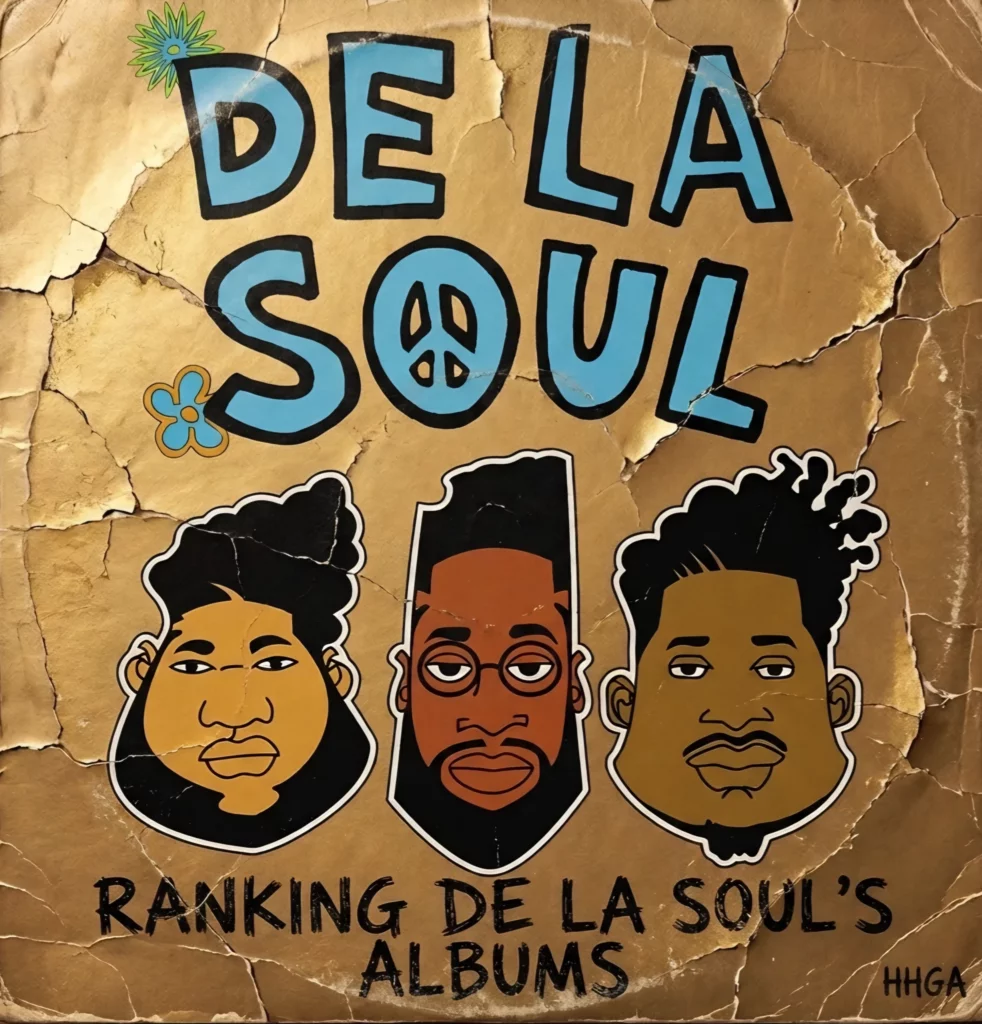
De La Soul helped expand the creative possibilities of Hip Hop while keeping the music playful, unpredictable, and deeply human. When Posdnuos, Trugoy the Dove, and Maseo arrived in 1989 with 3 Feet High and Rising, their approach was unlike anything else in rap. With Prince Paul behind the boards, the Long Island trio built an album around adventurous sampling, eccentric humor, inventive arrangements, and thoughtful lyrics. Songs like “Me, Myself and I,” “Eye Know,” and “Say No Go” introduced a group whose imagination extended well beyond the conventions of the genre at the time.
The three MCs refused to settle into a single identity. De La Soul Is Dead (1991) took a darker, more confrontational approach, challenging the group’s supposedly carefree image through biting humor and sharper social commentary. Buhloone Mindstate (1993) explored jazz influences and live instrumentation, while Stakes Is High (1996) delivered a pointed critique of commercial rap and the changing direction of Hip Hop. Four consecutive albums, each with a distinct musical personality, gave De La Soul one of the strongest creative runs in the genre’s history.
Their subsequent catalogue continued to take unexpected turns. The Art Official Intelligence albums explored new production styles and collaborations, although the planned trilogy never reached its intended conclusion. The Grind Date (2004) brought together an impressive collection of producers and guests, including Madlib, 9th Wonder, MF DOOM, and Ghostface Killah. Twelve years later, the group returned with and the Anonymous Nobody…, an independently funded project built around live musicians and an eclectic range of collaborators.
De La Soul’s extensive use of samples also brought years of legal complications, keeping much of their catalogue unavailable on major streaming platforms. Its arrival on streaming services in 2023 was a long-overdue development, although the celebration was overshadowed by the death of Trugoy the Dove in February of that year. His passing marked an enormous loss for Hip Hop and for the group.
Posdnuos and Maseo eventually returned with Cabin in the Sky (2025), a deeply personal album shaped by grief, remembrance, and the musical bond they shared with their longtime partner. We named it our Album of the Year, recognizing a remarkable continuation of De La Soul’s story.
Few groups have maintained such a distinctive identity across so many different phases of Hip Hop. From the sample-driven exuberance of their debut to the mature reflections of Cabin in the Sky, De La Soul’s catalogue offers an extraordinary range of ideas, sounds, and perspectives. Here’s our ranking of their studio albums.

10. Plug 1 & Plug 2 Present... First Serve (2012)

Technically, First Serve isn’t a De La Soul album, as Maseo is absent. Still, with Posdnuos and Trugoy the Dove responsible for two-thirds of the group’s creative force, and the project carrying much of De La Soul’s personality, we’ve included this concept album as an honorary entry in their discography. The two MCs step into the roles of Jacob “Pop Life” Barrow and Deen Witter, fictional rappers whose story unfolds like a Hip Hop biopic set against the late 1990s music industry.
The narrative follows their progression from basement recordings and early struggles to a record deal, commercial success, bitter rivalry, and eventual breakup. “Opening Credits” introduces the cinematic premise, while “The Work” and “Small Disasters” capture the frustrations of trying to make it as unknown MCs. “We Made It” celebrates their breakthrough, although the excitement of success gradually gives way to inflated egos and personal disagreements. “Clash Symphony” and “Pop Life” explore the growing hostility between the partners, while “Tennis” uses an entertaining back-and-forth dynamic to underline their dependence on each other. By the time “Ending Credits” brings the story to a close, friendship and their shared love of Hip Hop have won out over the temptations of fame.
French production duo Chokolate and Khalid provide a lively musical backdrop, drawing on funk, disco, boogie, and sample-based Hip Hop. The upbeat grooves recall the party-minded spirit of De La Soul’s earlier work, while giving Pop Life and Deen a musical identity of their own. Conceptually, First Serve deserves comparison with the narrative albums of Prince Paul, Masta Ace, Del, and Kool Keith. The storytelling is ambitious, and Posdnuos and Trugoy bring enough personality and lyrical skill to make their fictional counterparts convincing.
The execution isn’t always as strong as the idea. The skits and theatrical interludes occasionally interrupt the musical momentum, and the album lacks the standout songs that might have given it greater staying power. Minimal promotion also meant that First Serve flew under the radar. Still, there’s plenty to appreciate here, particularly for De La Soul fans interested in hearing Posdnuos and Trugoy approach a full-length project from an entirely different angle. | 7/10
9. and the Anonymous Nobody... (2016)

After a twelve-year gap between studio albums, De La Soul returned with a project that took their musical curiosity in an entirely different direction. Funded through a hugely successful Kickstarter campaign, and the Anonymous Nobody… gave Posdnuos, Trugoy the Dove, and Maseo the freedom to work outside the usual record-industry constraints. The album’s unusual production process involved recording more than 200 hours of live instrumentation with the Rhythm Roots All-Stars, which the group subsequently chopped, rearranged, and sampled themselves. The result is a warm, organic collection that moves between funk, soul, psychedelic rock, and Hip Hop.
The guest list is unusually extensive, with Snoop Dogg, 2 Chainz, Usher, Jill Scott, Damon Albarn, David Byrne, Little Dragon, and Roc Marciano among the contributors. For the most part, the collaborations work, even if De La Soul occasionally seem to take a back seat on their own album. “Pain,” featuring Snoop Dogg, rides an infectious groove, while “Memory of… (Us)” pairs Estelle with Pete Rock’s soulful production. “Property of Spitkicker.com” brings Roc Marciano into De La’s world, and “Greyhounds,” featuring Usher, is a particularly moving account of life on the road and the sacrifices that come with it.
The album’s more adventurous detours are less immediately rewarding. “Lord Intended,” featuring The Darkness frontman Justin Hawkins, is an extravagant rock-driven excursion that won’t appeal to every Hip Hop listener. “Drawn,” with Little Dragon, leans heavily into indie-pop territory, while “Here in After,” featuring Damon Albarn, takes another unexpected turn. These experiments give the record considerable variety, although the 68-minute running time and abundance of guest contributions occasionally leave us wishing for more space devoted to the three members themselves.
and the Anonymous Nobody… is a slow burn that rewards an open mind. Its loose, genre-hopping arrangements and willingness to follow ideas wherever they lead make it an intriguing addition to De La Soul’s catalogue. The album also carries particular historical significance as the last studio release during Trugoy’s lifetime. Some editing would have made it a stronger listening experience, but the ambition, musical warmth, and unexpected combinations give it a character all its own. | 7/10
8. Art Official Intelligence: Mosaic Thump (2000)

Following four consecutive albums of extraordinary creativity, De La Soul finally showed signs of settling into a more conventional approach with Art Official Intelligence: Mosaic Thump. That doesn’t make it a disappointment. The first installment of a planned trilogy, the album found Posdnuos, Trugoy, and Maseo embracing a more collaborative, party-oriented direction, with a lengthy guest list and a warmer, funkier production style. Some of the eccentricity of their earlier work takes a back seat, but the group’s musical chemistry and lyrical sharpness are still very much intact.
The guest appearances are a defining feature, and several produce excellent results. “Oooh.” pairs De La with Redman, whose energetic delivery fits perfectly with the track’s infectious groove. “All Good?” takes a smoother R&B direction, with Chaka Khan providing a memorable vocal performance. Busta Rhymes joins the group on the lively “I.C. Y’All,” while “My Writes” brings together Tash, J-Ro, and Xzibit for an entertaining posse cut. Elsewhere, J Dilla’s production on “Thru Ya City” adds a welcome dose of gritty, sample-driven Hip Hop.
Our personal highlight, however, is “Set The Mood.” Built around a wild, unpredictable beat from Mr. Khaliyl, the track gives Posdnuos room to deliver some particularly fierce rhymes, with guest MC Indeed adding to the intensity. It’s the kind of left-field production and sharp lyrical interplay that reminds us what makes De La Soul special. The album also has its share of less memorable material, and the abundance of guests occasionally leaves the three members competing for space on their own record. At over an hour, Mosaic Thump would have benefited from some trimming.
After the uncompromising direction of Stakes Is High, De La Soul clearly wanted to have some fun again. They succeeded, even if the results lack the consistency and adventurous spirit of their first four albums. “Oooh.,” “All Good?” and “Set The Mood” alone make this a worthwhile addition to their catalogue, and there’s plenty else to enjoy along the way. | 7/10
7. AOI: Bionix (2001)

With AOI: Bionix, De La Soul found a more satisfying direction for the Art Official Intelligence concept. The second installment of a planned trilogy, it trades much of the guest-heavy approach of Mosaic Thump for a warmer, more cohesive collection that reflects the group’s growing maturity. Posdnuos, Trugoy, and Maseo sound comfortable addressing subjects that come with getting older, including relationships, fatherhood, sexuality, religion, and the responsibilities of success. The result is an underappreciated album that deserves considerably more attention within their catalogue.
Supa Dave West handles much of the production, supplying smooth, soulful grooves with enough unexpected touches to keep things interesting. “Simply” is an excellent example, turning Paul McCartney’s “Wonderful Christmastime” into an irresistible Hip Hop loop. “Baby Phat,” featuring Devin the Dude and Yummy Bingham, is a humorous celebration of fuller-figured women, while “Held Down” is one of the album’s strongest moments. Posdnuos reflects on fatherhood, faith, and the pressures of raising children in a complicated world, with Cee-Lo Green adding a memorable gospel-influenced hook.
Elsewhere, “Special” brings a welcome contribution from producer Kev Brown, and J Dilla handles the excellent “Peer Pressure,” which features B-Real. Slick Rick joins the group on “What We Do (For Love),” a playful exploration of sexual discovery. There’s plenty of variety throughout, and the different production approaches give the album a character of its own without sacrificing the group’s chemistry.
The main drawback is the collection of Reverend Do Good skits scattered throughout the record. Some provide amusing social commentary, but their frequency disrupts the flow, particularly when several appear close together. The second half also loses some momentum, although tracks like “Pawn Star,” “Trying People,” and “What We Do (For Love)” keep the quality high.
AOI: Bionix may lack the consistency of De La Soul’s first four albums, but it improves on Mosaic Thump in several important respects. Its mature perspective, soulful production, and strong performances make it a rewarding listen, and there’s a good argument for giving it more credit than it usually receives. | 7.5/10
6. The Grind Date (2004)

After the sprawling AOI albums, De La Soul took a different approach with The Grind Date. Their seventh studio album is leaner, more direct, and noticeably more focused than its predecessors. Originally intended as the final chapter of the Art Official Intelligence trilogy, the project eventually developed its own identity, with the group putting AOI III on hold. The change suited them. Posdnuos, Trugoy, and Maseo were now veteran artists approaching their mid-thirties, and the album reflects a renewed concentration on the daily work of making Hip Hop. The familiar skits and elaborate detours are gone, leaving twelve tracks and just under 49 minutes of music.
The production lineup is a major attraction. J Dilla, Madlib, and 9th Wonder each contribute, while Supa Dave West handles five tracks. The different approaches give the album plenty of texture without compromising its cohesion. Dilla sets things off with the sharp, handclap-driven “Verbal Clap,” then teams up with DJ Premier on the soulful “Much More,” featuring Yummy Bingham. Madlib supplies the offbeat groove of “Shopping Bags (She Got From You)” and the infectious bounce of “Come On Down,” featuring Flavor Flav. 9th Wonder’s “Church,” with Spike Lee, takes a more reflective direction, while Supa Dave West provides much of the album’s underlying warmth.
The guest MCs are well chosen and never overwhelm the group. Ghostface Killah brings his unmistakable intensity to “He Comes,” Common joins Posdnuos and Trugoy on Jake One’s “Days of Our Lives,” and MF DOOM delivers a memorable performance on “Rock Co.Kane Flow.” The latter is a particular highlight, with DOOM and Posdnuos trading sharp, densely written verses over Jake One’s hard-hitting production. The track also finds Posdnuos aiming the growing tendency of rappers to announce their producers throughout their songs. There’s plenty of lyrical confidence on display across the album, and the two MCs sound completely at ease working alongside one another.
The concise format does wonders for the overall listening experience. There are no extended skits to interrupt the momentum, no unnecessary interludes, and very little that feels out of place. The Grind Date doesn’t have the playful eccentricity or conceptual ambition of De La Soul’s earlier classics, and its more straightforward approach occasionally sacrifices some of their distinctive personality. Still, the production is consistently strong, the performances are sharp, and the sequencing gives the album an appealing sense of purpose.
Often overlooked in discussions of De La Soul’s best work, The Grind Date deserves a higher place in the group’s later catalogue. It’s a confident, tightly assembled record that finds three veteran MCs concentrating on what they do best. | 8/10
5. Cabin In The Sky (2025)

Nine years after and the Anonymous Nobody…, De La Soul returned with an album shaped by the absence of David “Trugoy the Dove” Jolicoeur, who passed away in 2023. Cabin in the Sky, their tenth studio album, finds Posdnuos and Maseo reflecting on grief, memory, and the passage of time while holding on to the humor, musical curiosity, and chemistry that have defined the group for decades. The loss of Dave hangs over the record, but the music is full of life.
Released through Mass Appeal as part of Nas’ Legend Has It series, the album takes its title from the 1943 Black musical film and imagines a gathering somewhere beyond the earthly world. Giancarlo Esposito’s narration introduces a remarkable cast of friends and collaborators, including Nas, Q-Tip, Slick Rick, Common, Killer Mike, Black Thought, and Bilal. The moment Esposito mentions Dave and pauses is particularly affecting. This is a De La Soul album made in his memory, with his presence woven throughout.
The production lineup is equally impressive. DJ Premier, Pete Rock, Supa Dave West, Nottz, Jake One, Just Wazzx3, and Trugoy himself contribute warm, soulful beats that connect the group’s different eras without leaning too heavily on nostalgia. “YUHDONTSTOP” opens the musical proceedings with a loop created by Dave and a heartfelt verse from Posdnuos about aging and responsibility. On “Good Health,” Dave’s familiar warmth and sly humor come through beautifully, while Pete Rock’s “The Package” offers another moving exchange between the two MCs. DJ Premier’s “Sunny Storms” gives Pos room for some of his most thoughtful writing.
The guests fit naturally into the proceedings. Nas sounds energized on “Run It Back!!,” Q-Tip brings the warmth of an old friendship, and Slick Rick and Common contribute to “Yours.” Black Thought attacks Premier’s “EN EFF” with customary precision, while Killer Mike brings tenderness to “A Quick 16 for Mama.” Bilal’s appearance on “Palm of His Hands” is another emotional highlight.
Posdnuos anchors the album with reflections on grief, family, mortality, and legacy. The title track addresses these subjects directly, while the closing “Don’t Push Me” gives Dave the final word. Hearing his relaxed, unmistakable delivery is a fitting way to end the record.
Cabin in the Sky draws on everything from the playful spirit of 3 Feet High and Rising to the lyrical focus of Stakes Is High. Posdnuos and Maseo have made a moving, musically rich album that honors their fallen partner while keeping De La Soul’s creative spirit alive. 8.5/10
4. Buhloone Mindstate (1993)

Of De La Soul’s first four albums, Buhloone Mindstate is arguably the one that is the most underappreciated. Their third album finds Posdnuos, Trugoy, and Maseo taking another sharp turn, moving away from the dense sampling and playful skits of their earlier work toward a more organic, jazz-inflected sound. Prince Paul is still at the controls, but the production is leaner and more restrained, allowing the group’s writing and musical ideas to take center stage. It was also their final full collaboration with the producer, bringing an important chapter in De La Soul’s history to a close.
The title plays on the idea of a balloon: the group was growing in popularity, but had no intention of going pop. That independent-minded attitude runs throughout the album. With gangsta rap and harder-edged East Coast Hip Hop gaining ground in 1993, De La Soul refused to chase prevailing trends or dilute their identity. Instead, they expanded their musical palette, bringing in jazz veterans Maceo Parker, Fred Wesley, and Pee Wee Ellis. Their contributions give “Patti Dooke” and “I Am I Be” a vibrant live-band character, while Parker’s saxophone drives the instrumental “I Be Blowin’.” Prince Paul’s use of jazz samples, including material from Eddie Harris, Lou Donaldson, Duke Pearson, and Milt Jackson, adds depth and warmth to the production.
There’s plenty of variety across the tracklist. “Breakadawn” builds a beautiful groove around Michael Jackson’s “I Can’t Help It,” while “En Focus,” featuring Dres of Black Sheep and Shortie No Mass, is another standout. Guru’s spoken contribution to “Patti Dooke” and Biz Markie’s appearance on “Stone Age” add familiar voices, while the brief “Long Island Wildin’” brings Japanese Hip Hop duo Scha Dara Parr into the mix. The album’s shorter tracks and instrumental passages also contribute to its cohesive, almost continuous flow.
Buhloone Mindstate may lack the immediate accessibility of 3 Feet High and Rising, but its musical sophistication and lyrical depth reward repeated listening. Posdnuos and Trugoy sound increasingly assured, and Prince Paul’s production is consistently inventive without becoming overbearing. We consider it every bit as accomplished as De La Soul’s other early classics. | 9/10
3. Stakes Is High (1996)

By the time De La Soul released Stakes Is High, the group had moved a long way from the playful psychedelia of 3 Feet High and Rising. Their fourth album finds Posdnuos, Trugoy the Dove, and Maseo taking stock of a Hip Hop culture increasingly shaped by gangsta rap, commercial competition, and material ambition. The mood is more serious, the approach more direct, and the music stripped of many of the eccentric detours that characterized their earlier work. There’s no shortage of personality, though. De La Soul sound like three veteran MCs with plenty to say and no interest in compromising their principles.
The title track, produced by a young J Dilla, is the album’s defining moment. Its warm horn sample and understated drums provide the backdrop for Posdnuos to address gun violence, racism, and the direction of rap music. His measured delivery makes the frustration all the more effective. Dilla contributes several other beats, bringing an economical, sample-driven approach that gives the album much of its distinctive character. De La Soul handle the bulk of the remaining production themselves, keeping the sound cohesive without relying on the elaborate sample collages of their earlier records.
The lyrical focus is equally strong throughout. “Supa Emcees” questions the priorities of contemporary rappers, while “The Bizness,” featuring Common, takes aim at the compromises and pressures of the music industry. “Dog Eat Dog” approaches the competitive climate with a touch of the group’s familiar humor, and “Itzsoweezee (HOT)” delivers a tougher performance from Posdnuos and Trugoy. “Big Brother Beat,” featuring Mos Def, is another highlight, with the chemistry between the MCs making the collaboration particularly effective.
Despite its more serious subject matter, the album never becomes a lecture. Maseo’s contributions and the trio’s natural chemistry keep the music lively, while the production gives each track room to breathe. The seventeen-song tracklist is remarkably consistent, with little filler to interrupt the momentum.
All four of De La Soul’s first albums have a legitimate claim to classic status, but Stakes Is High may be their most mature and focused statement. Its concerns are rooted in the Hip Hop landscape of 1996, yet its questions about artistic integrity, commercial pressure, and violence have lost little of their relevance. Nearly a decade into their career, De La Soul were still evolving, still challenging themselves, and still making outstanding Hip Hop. | 9/10
2. De La Soul Is Dead (1991)

After the success of 3 Feet High and Rising, De La Soul faced the familiar problem of being defined by a breakthrough debut. Their colorful D.A.I.S.Y. Age identity had earned them critical acclaim, but the association with Hip Hop’s happy-go-lucky hippies threatened to become a creative straitjacket. Released in 1991, De La Soul Is Dead was a deliberate rejection of those expectations. Darker, more cynical, and musically adventurous, the album found Posdnuos, Trugoy, and Maseo determined to move beyond the image that had followed them since their arrival.
The title and cover, featuring a smashed flowerpot, make their intentions clear. A series of skits follows neighborhood bullies who discover a De La Soul cassette in the trash and ridicule the group’s music. It’s an amusing running concept, although the jokes also give the album a confrontational edge. Prince Paul’s production is even more unpredictable than on the debut, combining unusual samples, vocal fragments, shifting rhythms, and unexpected changes in mood. “Oodles of O’s” and “Talkin’ Bout Hey Love” capture the group’s distinctive musical imagination, while “A Roller Skating Jam Named ‘Saturdays’” delivers an irresistible disco groove. “Ring Ring Ring (Ha Ha Hey)” turns its attention to aspiring artists and opportunists looking to exploit De La Soul’s success.
The subject matter takes some considerably darker turns. “My Brother’s a Basehead” examines the destructive effects of drug addiction, while “Millie Pulled a Pistol on Santa” tells a disturbing story of sexual abuse and revenge. Both tracks reveal a more serious side to the group’s writing, adding emotional depth to an album that might otherwise be remembered primarily for its eccentric humor. The skits and occasional diversions can interrupt the musical flow, but the ambition and variety make for a fascinating listening experience.
De La Soul Is Dead initially challenged listeners expecting another 3 Feet High and Rising. In retrospect, that willingness to dismantle their own image is precisely what makes the album so important. Prince Paul delivers some of his most inventive production, while the three MCs sound increasingly confident in their ability to tackle different subjects and moods. De La Soul refused to become caricatures of their debut, and made an outstanding album in the process. | 9/10
1. 3 Feet High & Rising (1989)

When De La Soul released 3 Feet High and Rising in February 1989, Hip Hop gained an entirely different kind of group. While gangsta rap and hardcore lyricism were gaining momentum, Posdnuos, Trugoy the Dove, and Maseo arrived with surreal humor, playful wordplay, positive messages, and an adventurous approach to music. Working with producer Prince Paul, they created a debut that challenged the conventions of the genre and helped establish the alternative Hip Hop movement associated with the Native Tongues collective.
The production is extraordinary in its range and imagination. Drawing from funk, soul, psychedelic rock, doo-wop, children’s records, and even French language-learning tapes, Prince Paul and De La Soul assembled a kaleidoscopic collection of sounds through inventive sampling and unexpected arrangements. “The Magic Number,” “Potholes in My Lawn,” “Eye Know,” and “Say No Go” each reveal a different aspect of their musical curiosity. “Me Myself and I” became an anthem of individuality, while “Buddy,” featuring Jungle Brothers and A Tribe Called Quest’s Q-Tip, captured the collaborative spirit of the Native Tongues. The group’s D.A.I.S.Y. Age philosophy, short for “Da Inner Sound, Y’all,” also found its way into the colorful, flower-covered artwork.
The album’s 24 tracks are connected by recurring quiz-show skits, an unusual device that helped give 3 Feet High and Rising its own identity. The skits can interrupt the musical flow, and their novelty has inevitably faded somewhat over time, but they also contribute to the record’s eccentric charm. The sheer variety of ideas makes the album an unpredictable and consistently entertaining listen.
Alongside Jungle Brothers’ Straight Out the Jungle (1988), De La Soul’s debut helped open the door for artists such as A Tribe Called Quest, The Pharcyde, Freestyle Fellowship, and Digable Planets. Its influence on alternative and experimental Hip Hop is enormous. Almost four decades later, 3 Feet High and Rising still sounds wonderfully imaginative, full of personality, and unlike anything that came before it. A genuine classic and a fitting number one in our De La Soul ranking. | 10/10