


By the time Ice-T released O.G. Original Gangster in 1991, he had already built an impressive catalogue of solo work. His 1987 debut, Rhyme Pays, was one of the early rap albums with clear gangsta rap themes, introducing his distinctive combination of street narratives, cool-headed delivery, and West Coast attitude. Power (1988) expanded that approach, while The Iceberg/Freedom of Speech… Just Watch What You Say! (1989) brought his political and social commentary further to the foreground. Across those first three albums, Ice developed a voice that was recognisably his own: direct and articulate, grounded in personal experience, and increasingly interested in the circumstances behind the stories he told.
A former street hustler who knew the environment he described, Ice had always approached street life with a perspective that extended beyond its immediate details. He understood the appeal of the gangsta persona, but was also interested in the choices people made within that world and the consequences that followed. O.G. Original Gangster brings these different sides of his writing together. Across 24 tracks and more than 72 minutes, Ice moves between gangsta rap, political commentary, humour, personal observation, and reflections on the music industry. The album is expansive, occasionally unruly, and full of different approaches to its subject matter. Its central concern, however, remains consistent: understanding the world that produced the gangsta persona, while questioning the conditions that keep that world in place.
That perspective gives O.G. Original Gangster its particular character. Across 24 tracks and more than 72 minutes, Ice moves between gangsta rap, political commentary, humour, personal observation, and reflections on the music industry. The album is expansive, occasionally unruly, and full of different approaches to its subject matter. Its central concern, however, remains consistent: understanding the world that produced the gangsta persona, while questioning the conditions that keep that world in place. Where some of his contemporaries concentrated on the excitement and aggression of street life, Ice was more inclined to examine the machinery behind it.
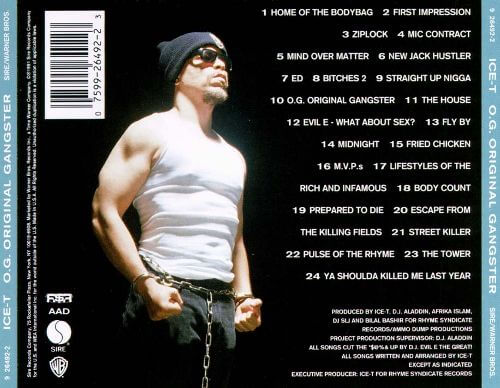
The opening track, “First Impression,” introduces that wider perspective in an unusual way. A British woman offers an enthusiastic assessment of Ice after listening to his music, describing him as an embodiment of urban experience and struggle. The exchange has a humorous quality, but it also establishes the different sides of his identity that run through the album. Ice is the gangsta rapper whose credibility comes from personal experience, the articulate observer who can discuss the social conditions around him, and the performer who understands the appeal of his own image. These roles are not always comfortable companions, and the album draws much of its interest from the tension between them.
“New Jack Hustler,” originally recorded for the New Jack City soundtrack, is one of the clearest examples of Ice’s ability to work within the conventions of gangsta rap while bringing a critical perspective to the material. He adopts the viewpoint of a young drug dealer enjoying the money, cars, clothes, and attention that accompany his criminal success. The track has an urgent musical drive, built around relentless guitars and well-timed drum breaks. Its narrator is caught up in the rewards of the hustler lifestyle, but the story gradually reveals the cycle behind the fantasy. Poverty, crime, imprisonment, and the lack of meaningful alternatives keep producing new generations of young dealers. The character’s apparent success is temporary, and the world that created him remains unchanged. Ice does not need to step outside the narrative to make the point. The consequences are already present in the story.
That ability to move between characterisation and commentary is one of the album’s defining strengths. Ice understands the attraction of the gangsta image, and he is not interested in pretending that the lifestyle has no appeal to the people drawn into it. At the same time, he refuses to treat criminal success as an uncomplicated victory. The title track makes the album’s wider intentions clearer, arguing for the importance of political Hip Hop and the need for rappers to address the circumstances surrounding their communities. Ice’s approach is rarely abstract. He prefers plain language and recognisable situations, connecting larger social questions to the experiences of people living through them.
Questions of language and identity also receive attention. On “Bitches 2,” Ice responds to criticism of his use of the word “b****,” arguing that it can be applied to men as well as women. The track approaches the subject with humour, supported by horns and piano rather than the darker musical settings found elsewhere on the album. “Straight Up N****” addresses criticism of his use of the N-word. Ice asserts his right to identify himself on his own terms, refusing to let outside opinion determine how he uses the word. These tracks are not presented as detached debates. They are part of Ice’s broader insistence on speaking in his own voice, even when that voice makes people uncomfortable.
The production gives the album a clear, polished sound without limiting its range. DJ Aladdin, Afrika Islam, and SLJ contribute to a musical backdrop built around funk and soul samples, precise drum programming, and carefully arranged layers. The mix is clean, with individual elements given room to breathe. That clarity suits Ice’s delivery, which is measured and conversational rather than dependent on elaborate vocal theatrics. “Mind Over Matter” is a particularly effective example. Drawing on Funkadelic’s “I Bet You” and James Brown’s “Mind Power,” the track takes a slower, subtler approach as Ice reflects on writing, creativity, and the importance of using his mind to earn a living. It offers a different kind of self-portrait from the street narratives, presenting the discipline and intelligence behind the performer.
There is room for lighter material, too. “Fried Chicken” and “M.V.P.’s” provide some of the album’s more playful moments, while “Lifestyles of the Rich and Infamous” looks at the complications of life as a successful rapper. Ice describes the backstage side of the business rather than presenting celebrity as an uncomplicated reward. The track adds another dimension to an album that repeatedly questions the difference between the image people see and the realities behind it. On “Body Count,” he introduces his hardcore metal band of the same name. The track points towards another outlet for his musical interests and political anger, showing that his creative identity was never confined to rap.
The darker material in the album’s second half returns to the consequences of the world described on “New Jack Hustler.” “Midnight” revisits the nighttime street narrative of “6 ‘N the Mornin’,” but gives it a more ominous musical setting. The track combines the guitar riff from Black Sabbath’s “Black Sabbath” with the drums from Led Zeppelin’s “When the Levee Breaks.” The result is a tense, unsettling backdrop for a story that ends with the police kicking down the narrator’s door. Where “6 ‘N the Mornin'” helped establish Ice’s approach to the gangsta narrative, “Midnight” revisits that territory with a darker atmosphere and a clear sense of the danger surrounding its central character.
“Escape From the Killing Fields” takes the discussion beyond individual street encounters. Ice addresses the economic and psychological conditions that trap people in inner-city environments, describing a system in which poor schools, inadequate public services, and limited opportunities leave residents with few ways forward. His call for gang members to break the mental chains of their surroundings is rooted in the recognition that the prison system begins long before someone is physically incarcerated. The track connects street violence to structural problems, placing responsibility in a wider context without denying the damage caused by individual actions.
“The Tower” moves that concern into the prison environment. Built around John Carpenter’s Halloween theme, the track tells a story of violence, survival, and gang allegiances behind bars. Its use of the familiar horror-film music gives the narrative an appropriately threatening atmosphere. Prison becomes another enclosed world with its own rules and dangers, extending the album’s interest in systems of confinement. Whether on the street or inside a correctional institution, Ice repeatedly returns to environments in which violence shapes everyday decisions and escape is difficult.

The album’s length is considerable, and its 24 tracks do not all make the same impression. Some of the lighter material interrupts the darker narrative, and not every guest appearance adds much to the proceedings. But the variety is also part of the record’s identity. Ice moves between different subjects and musical settings while retaining a remarkably consistent voice. He can be funny, confrontational, reflective, or politically direct without losing the sense that these perspectives belong to the same person. The production remains clear and controlled throughout, giving the album a cohesive sound despite its considerable scope.
O.G. Original Gangster captures Ice-T at a point when his position in Hip Hop allowed him to look back at the gangsta rap persona while continuing to inhabit it. He understood its appeal, its language, and its place in the culture, but he was equally interested in the conditions that made it necessary and the consequences that followed. The album does not offer easy answers, and its social commentary is delivered in the same straightforward language as its street narratives. That is precisely what gives it much of its force. Its final question, “Is this a nightmare or the American dream?”, brings the contradiction into focus. On O.G. Original Gangster, Ice-T examines that contradiction from several angles, making one of his most ambitious and insightful records.