

The first minute of “Swedish Death Cleaning” holds almost everything back. Blockhead lets a piano loop and a few synth tones ring out on their own while Aesop Rock starts unwinding a knotted list of objects and odd nouns over them. A run of arpeggios comes in about a minute later, and the drums only land once the verse is over. It’s a strange way to open an album by two people who have spent three decades locking beats and bars together, and it tells you how comfortable they are with each other. Nobody here needs to prove the chemistry on the first downbeat.
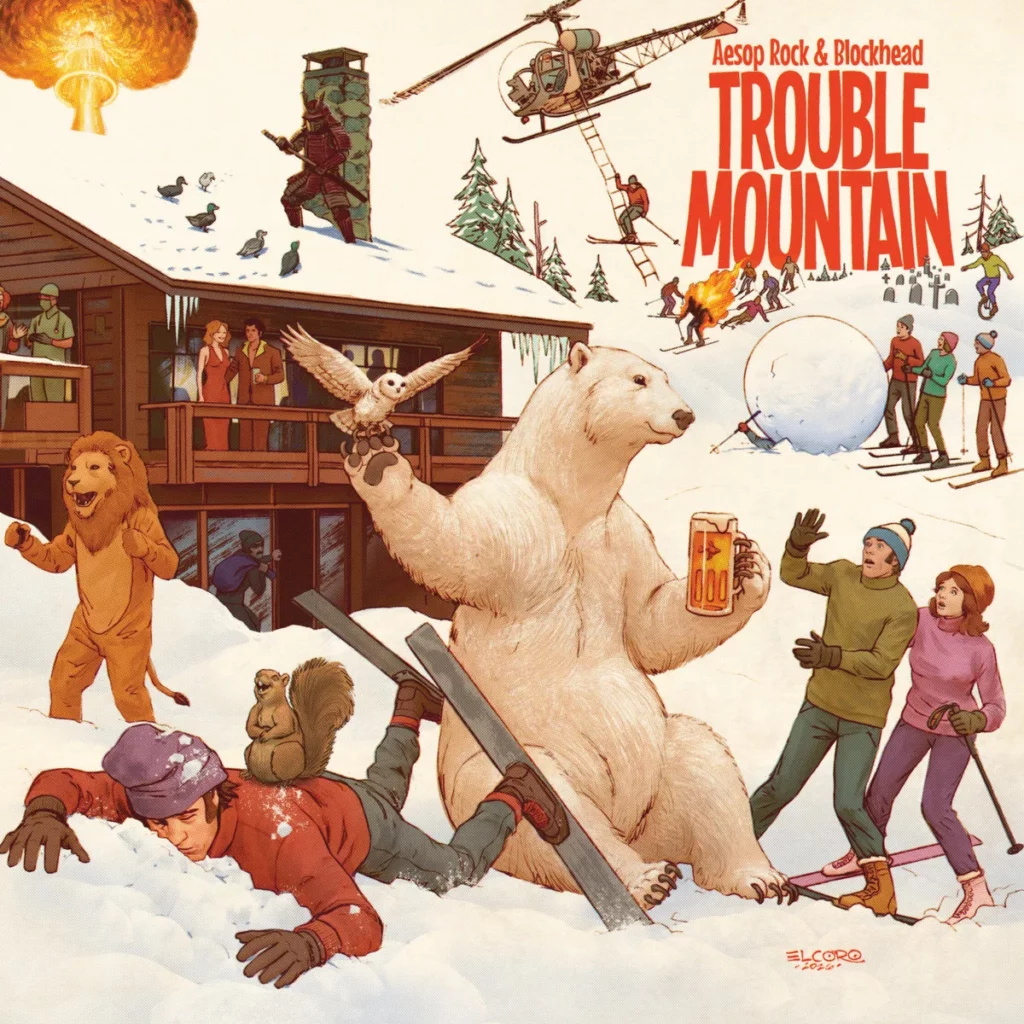
Trouble Mountain is the second fully collaborative album from Aesop Rock and Blockhead, following 2021’s Garbology. It arrived on November 13 through Rhymesayers Entertainment. It’s Aesop Rock’s 13th studio album and his sixth full-length since 2020, a run that includes the largely self-produced Integrated Tech Solutions and Black Hole Superette, plus the surprise free download I Heard It’s a Mess There Too. He is one of our favorite rappers of the post-2000 era, and putting out that much music hasn’t made his writing any less precise.
This time the frame is a fictional, slightly run-down ski resort. It’s modelled on the Poconos getaway commercials that played on loop during the pair’s New York childhoods. Like most Aesop Rock concepts, it’s a loose one: the lodge appears, wanders off and comes back. “TM Tours” is a 27-second synthwave advert made with Baby Dayliner, and it sells the place as somewhere you can get into some trouble. The album takes the offer literally. On lead single “Trouble Trouble,” the mountain is a heap of baggage, old injuries and daily indignities. Aes climbs it over Blockhead’s cinematic funk, then decides a Saint Bernard bringing cocoa, baked brie and mushroom risotto would sort everything out. That swerve from dread to menu planning sums up the album’s personality.
Blockhead is the main reason the album has so much range. Garbology held one patient, low-lit mood from start to finish. Here the mood changes from track to track. “Easter” is jazz-funk noir, with Aes narrating a tent city that slides into tribal warfare. “Coyote Summer,” the second single and a feature for Hanni El Khatib, is jazzier and looser. It also carries a fond nod to Blockhead (born Tony Simon) as Uncle Tony, sizing up every notable drummer in range. “Church Key” stacks shimmering, psychedelic layers into the album’s most propulsive arrangement, and it recalls the duo’s “None Shall Pass” more directly than anything else here. Elsewhere Blockhead drops back to sparse organ or a bare loop, then hits with boom-bap weight on the next song. The sequencing keeps you guessing without the record coming apart.
Aesop’s writing has grown warmer and stranger at the same time. “Mom One” is the emotional centre. A childhood memory of trying, and failing, to forge his mother’s signature becomes a case that her handwriting was so fine she might have been the greatest graffiti writer who ever lived. It’s a ridiculous premise delivered with real tenderness. “Hound Selector” finds him taking in a dog that reminds him a little too much of himself. “Oatmeal,” one of the strongest cuts, is built on a morning routine of the same bowl of oats and the same word games, and he makes repetition sound like a coping strategy and a small act of devotion at once. His flows bend more than they did in the Def Jux days. The bars are still packed tight, but he leaves room between phrases, doubles back on rhythms and lands punchlines from angles you don’t see coming.
The guest list is far wider than on Garbology. Open Mike Eagle is an ideal foil on “One Thing,” matching Aes deadpan for deadpan and working in wrestling references to Ric Flair and Ole Anderson. “Eat and Grow” brings in Cavalier and 4-IZE for a posse cut about building strength from the ground up. The extra voices break the hour-long album into manageable stretches.
The back half turns from character sketches to the systems around them. Third single “Ants” surveys the land from a height where everyone looks tiny. “No Interviews” goes after the state of the media, and “The Bag” picks at what capitalism does to ordinary lives. Aes has worked that ground since Labor Days, and he brings fresh specifics to it here. “Ewok” admits he never ends up where he said he was going. “Buffering” closes the album with light pouring from eyes and mouths and a shrug at anyone lining up to count you out.
Seventeen tracks of Aesop Rock’s lyrical density is a lot to take in, and the album pays off over several listens rather than one. The resort concept also disappears for long stretches. Anyone hoping for something as tightly focused as Labor Days will find a tour guide who keeps leaving the trail. We’d argue the wandering is the point. The places we run to are as baffling as the ones we leave behind, and a ski lodge where your problems ride the lift with you is a sharper image than a neat story would allow.
What lingers is the sound of two people who know each other’s instincts well enough to leave gaps. Blockhead knows when Aes needs a bare loop and when he needs a full band behind him. Aes knows when to stop rapping and let the beat finally drop. Twenty-five years after “Daylight,” that trust has produced some of the most inventive music either of them has made.
8.5/10
Also read: The Best Hip Hop Albums Of 2026