

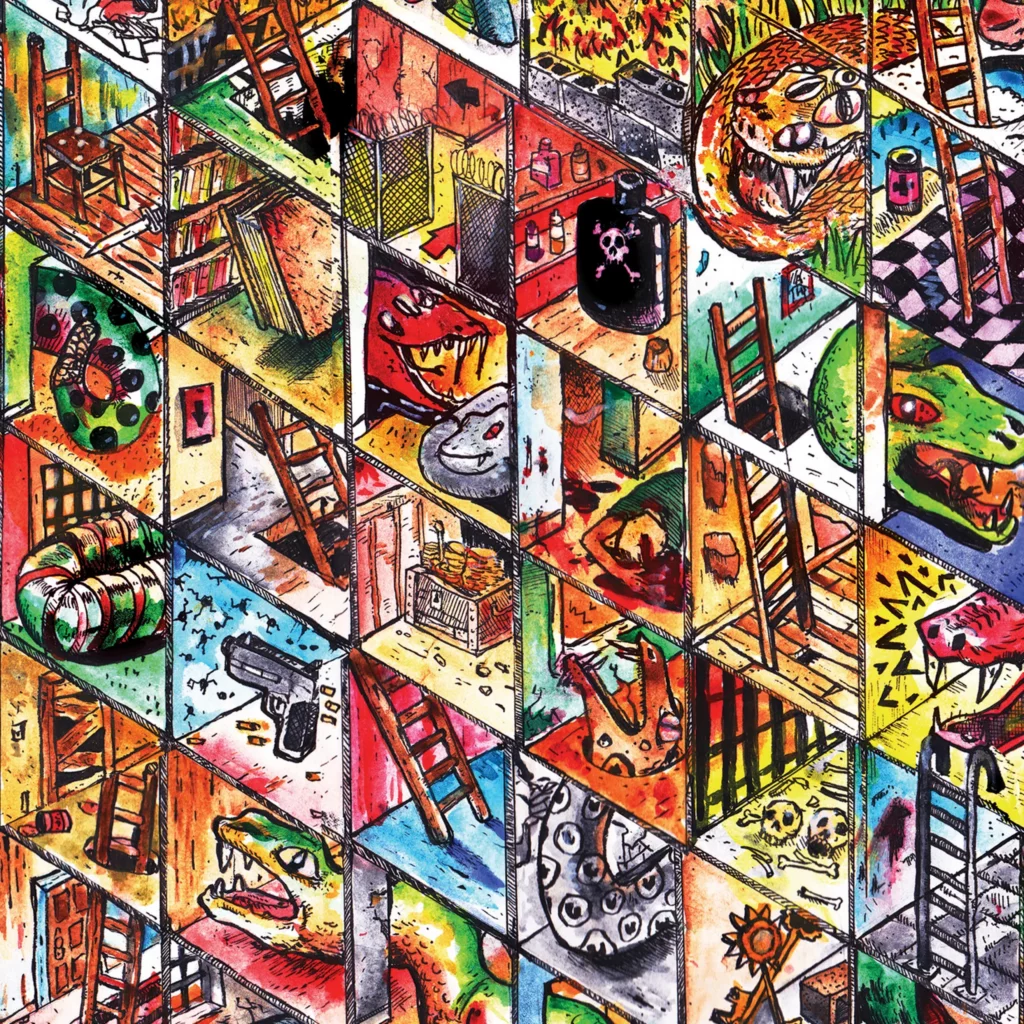
The album opens on locks. “Deadbolts,” produced by clipping., grinds into life with harsh industrial textures, and billy woods and ELUCID use it to pick apart the difference between being alone and living in a state of aloneness. It’s a fitting first step into an album about security, isolation and the systems that decide who gets ahead. Armand Hammer released Snakes & Ladders with no advance notice on November 11 through Backwoodz Studioz, a year after Mercy. It’s their eighth album, and with 16 tracks in 43 minutes, several of them under two minutes, one of their most compact.
That compactness sets it apart from its two predecessors. Mercy found the Alchemist cutting his sound down to a handful of elements and holding the duo inside it. We Buy Diabetic Test Strips brought together more than a dozen producers and still played as one carefully planned whole. Snakes & Ladders goes back to the many-hands approach of the latter, with clipping., Kenny Segal, Sebb Bash, Animoss and Preservation among the contributors. This time, the results are less even.
Start with the writing, because it is the strength of the record. Armand Hammer have always been political, but their politics usually arrive in code, through history and metaphor and images that take several listens to decode. Here the targets are named and current. “Lock Out (Tag Out)” takes its title from the safety procedure for shutting down industrial machinery, and over a Sebb Bash beat that blends jazz rap with boom bap drums, the duo turns to the data centers that guzzle resources to keep artificial intelligence cool. “Assembly Lines” follows the same thread to its bleakly comic end: a job application that leads to an interview, and an interviewer who turns out to be a chatbot. Preservation scores it with clanking, industrial grit that sounds like a factory running with no one inside.
“Nightswim” is where surveillance comes into view. Over guitars, the two rappers trace the spread of license-plate-reading Flock cameras across American streets, and the song has the slow, watchful tension of someone aware that they’re being recorded. ELUCID is the center of gravity on this track and across most of the album. His verses are pressured and urgent, crammed with imagery, and his voice cuts through the mix with an intensity he has rarely matched. Listeners have singled out his performances since the album dropped, and they’re right to. This is his record more than any Armand Hammer album before it.

woods gets his showcase on “Gravity,” a solo track that closes the first half. Over warm, soulful production, he slows down and lets a rare tenderness show through, and the effect after so much tension is startling. “don’t say it if it isn’t true” works in a similar register, a short, blunt plea for honesty from people who toss around love without meaning it. “Jet Magazine,” named after the long-running Black weekly, swings the other way, aiming its scorn at people with shallow roots who don’t share the realities the duo is describing.
The second half leans harder into atmosphere. Animoss sets “Vespers” to a bed of pianos as the duo describes crying in a club called nowhere. “Dragon Teeth” is a brief two-part piece that swaps calculation for prophecy and insists that freedom and compliance are two different things. On “Dogville,” the jazzier textures come back, and the song’s picture of a place where snakes slide around with ease reads as the closest thing to a title track: a board on which the ladders are scarce and the snakes are everywhere.
“Risk” breaks the mood late. $ilkMoney joins the duo for a burst of aggression, the three rappers circling violent impulses over a beat with real bite, and the jolt is welcome after the drift of “Dogville.” The album then ends on “if we must die,” a title it shares with Claude McKay’s defiant 1919 sonnet, written during the racial violence of the Red Summer. Closing on that phrase places the album in a long tradition of Black writing that answers danger by standing its ground.
For all that, the music doesn’t always rise to the writing. Much of Snakes & Ladders is built on jazzy, drumless beats, and the approach works in places. Kenny Segal strips out the percussion on “Send for Me” so the two voices carry the rhythm themselves, and the space gives their verses an unusual intimacy. Repeated across the album, though, the method starts to blur. “TimeTables,” at a minute and a half, passes before it settles into anything. “Incidentals” and the abrasive, experimental “Graveside” sound like sketches more than finished songs. Some of these beats come across as leftovers from earlier sessions, ideas that didn’t make the cut for We Buy Diabetic Test Strips or the Alchemist records and got a second chance here.
The trouble isn’t the number of producers. Armand Hammer have handled big rosters before, and Rome and We Buy Diabetic Test Strips both proved the duo’s voices can hold wildly different beats together. The trouble is that too many of these tracks share the same hazy, drumless palette without the sequencing to give them shape. The best moments, “Deadbolts,” “Assembly Lines,” “Nightswim,” “Risk,” hit hard because something in the beat pushes back against the rappers. Elsewhere, the music lies flat and lets them do all the work.
Snakes & Ladders is the sound of a group with urgent things to say and a need to say them now, and that urgency is the album’s best quality and the source of its rough edges. The writing climbs every ladder on the board. The beats keep sending it back a few squares.
7.5/10
Also read: The Best Hip Hop Albums Of 2026
Also read: Ranking billy woods’ Albums