

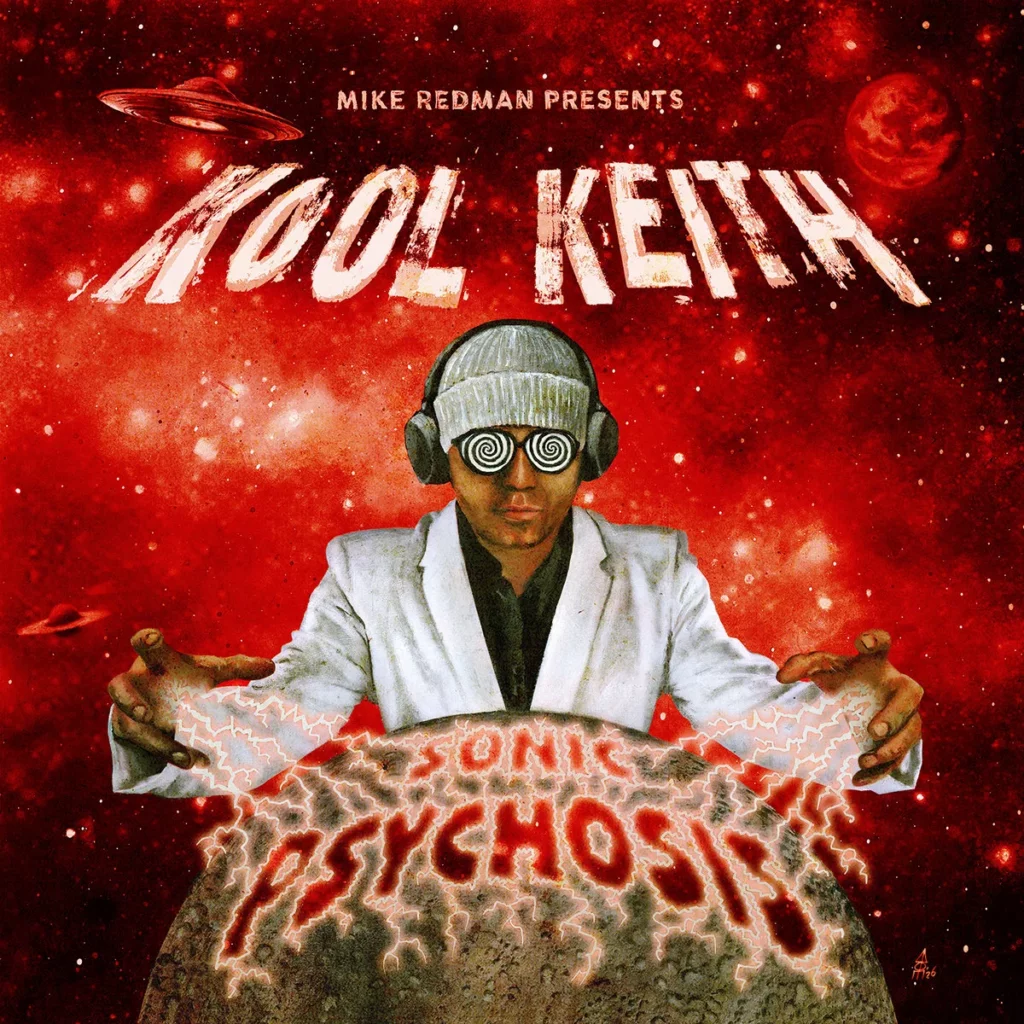
Kool Keith has always been one of our favorite Hip Hop artists. That may sound like a personal footnote, though it matters when discussing Sonic Psychosis. Keith is one of the great anomalies in rap history, a Bronx original whose career has rarely followed any sensible path. From the Ultramagnetic MCs and the bizarre brilliance of Critical Beatdown to Dr. Octagonecologyst, Sex Style, First Come, First Served, Black Elvis, Dr. Dooom and countless other projects, he has spent four decades making records on his own strange terms. His catalog is enormous, and its quality is inconsistent. So almost everybody’s would be at that volume. But Keith still has more great albums than most rappers ever manage to release.
That is why his near-total absence from “best ever” conversations is a serious fault of Hip Hop listeners. Keith’s influence runs through abstract rap, underground Hip Hop and artists who treat the microphone as a place for invention rather than conventional storytelling. His stream-of-consciousness writing, fractured rhyme patterns, bizarre characters and refusal to behave like a conventional rap star have inspired generations of not-conventional rappers.
Recent years have produced plenty of interesting, often obscure Keith releases, even when the overall quality has been uneven. Middi Magazine with Emperor Middi was quite dope earlier this year, while 2024’s Stress Eater with CZARFACE was another highlight. Then there was the 2023 double hit of Black Elvis 2 and Serpent, with the latter arguably his best album of the past decade. Sonic Psychosis feels like the most substantial Keith release since then.
A major reason is Mike Redman. The Rotterdam producer handles almost the entire album, and the pairing makes immediate sense. Redman’s production gives Keith a consistent musical environment for 50 minutes. Heavy drums, strange samples, scratches, industrial textures and futuristic noises create a murky, late-night atmosphere without turning every track into an exercise in abstraction. There is plenty of boom-bap here, though Redman keeps warping it around the edges. “The Ultramagnetic” and “Extended Lunchbreak” establish the tone quickly, while “Giant Robot” leans into the sci-fi side of Keith’s imagination. “Lyrical Insanity” brings Ras Kass and DJ Lord into the mix over a suitably aggressive beat.
The production is especially effective because nothing sounds rushed. Sonic Psychosis has a deliberate sense of construction. The instrumentals were recorded at Redrum Studios in Rotterdam, Keith’s vocals were recorded in New York, and the whole thing has the character of a proper album rather than a collection of tracks assembled whenever somebody had time. Even the scratches have a clear role. Redman handles most of them, with DJ Lord taking over on “Lyrical Insanity” and the title track, DJ Shadow appearing on “Uh-Oh, It’s Me Again,” and Trackstar the DJ cutting up “From Beyond the Galaxy.”

And then there is Keith himself.
At this point, nobody should expect him to explain himself. Keith throws out images, characters, references, and odd little observations with the same instinct that has defined his work since Ultramagnetic MCs. On “I’m a Nite Rider,” he occupies his familiar surreal territory, while “Psychedelic” brings Killah Priest into the strange orbit. The interlude “What on Earth is That” is almost a mission statement in instrumental form.
You can never be entirely sure where Keith is taking the next verse, which is precisely the appeal. His voice remains instantly recognizable. That high, nasal delivery cuts through Redman’s dense production, while his phrasing still has the ability to make an ordinary bar sound slightly alien. Keith has never needed conventional punchlines to hold attention. His best writing works through accumulation. One strange image leads to another, then another, until the verse develops its own internal logic.
“Ultraman 7000” is a good example. Additional words from Rah Digga and live drums from Salle de Jonge add extra texture, while Keith runs through another sequence of comic-book and futuristic imagery. “Traveling Through Time” brings Del the Funky Homosapien into the picture, a particularly appropriate pairing given Del’s own history of eccentric, futuristic Hip Hop. “Times Square” with Craig G shifts the setting again, grounding the album in New York while retaining its warped perspective.
The guest list is ridiculous in the best possible way. Ras Kass, Killah Priest, Del, Craig G, Sadat X, Mr. Lif, Young Zee and Chuck D all appear, alongside DJs whose reputations carry serious weight. “From Beyond the Galaxy” gathers Sadat X, Mr. Lif and Young Zee around Trackstar’s cuts. The lineup gives the record a wider Hip Hop history without turning it into a nostalgia exercise.
“Uh-Oh, It’s Me Again” is another highlight, with DJ Shadow co-producing and scratching. The track gives the album one of its clearest connections to the experimental side of Hip Hop that Keith helped make possible. Shadow knows how to build tension through texture, and his contribution fits naturally into Redman’s larger approach.
The final stretch works especially well. After all the guest appearances and stylistic detours, “Sonic Psychosis” brings the record back to its central pairing: Keith’s unpredictable voice and Redman’s heavy production. It closes an album that has maintained a remarkably consistent identity despite the number of people involved. “Sonic Psychosis” brings Chuck D and DJ Lord together with Keith, giving us a collaboration that seems almost strange in its absence from the history books. Chuck D’s commanding presence provides a useful anchor for Keith’s more unpredictable delivery, while DJ Lord’s scratches push the track toward the kind of hard-edged Hip Hop Keith has been adjacent to throughout his career. Additional words from George Clinton and Kid Capri add another layer to an already crowded meeting of Hip Hop minds.
The liner notes include a statement that no form of AI was used in creating the album. That detail fits the spirit of the project. The cover was hand-painted by Redman, the production was built in Rotterdam, the scratches were performed by actual DJs, and the album has the slightly obsessive character of people taking time to make something weird properly. Even the imperfections belong to the process.
Kool Keith has never needed another classic album to prove his importance. He established that decades ago. What Sonic Psychosis does provide is something his enormous discography has occasionally lacked: a coherent sonic vision from beginning to end. Mike Redman gives Keith a world and lets him run around inside it.
That makes this one of the most convincing Kool Keith releases in years. The guest list is stacked, the production stays focused, and Keith is still Keith. Strange, funny, unpredictable, occasionally incomprehensible, always worth listening to closely.
Hip Hop has spent decades underappreciating one of its most original pioneers. Sonic Psychosis is another reason to stop doing that.
8/10
Also read: The Best Hip Hop Albums Of 2026