

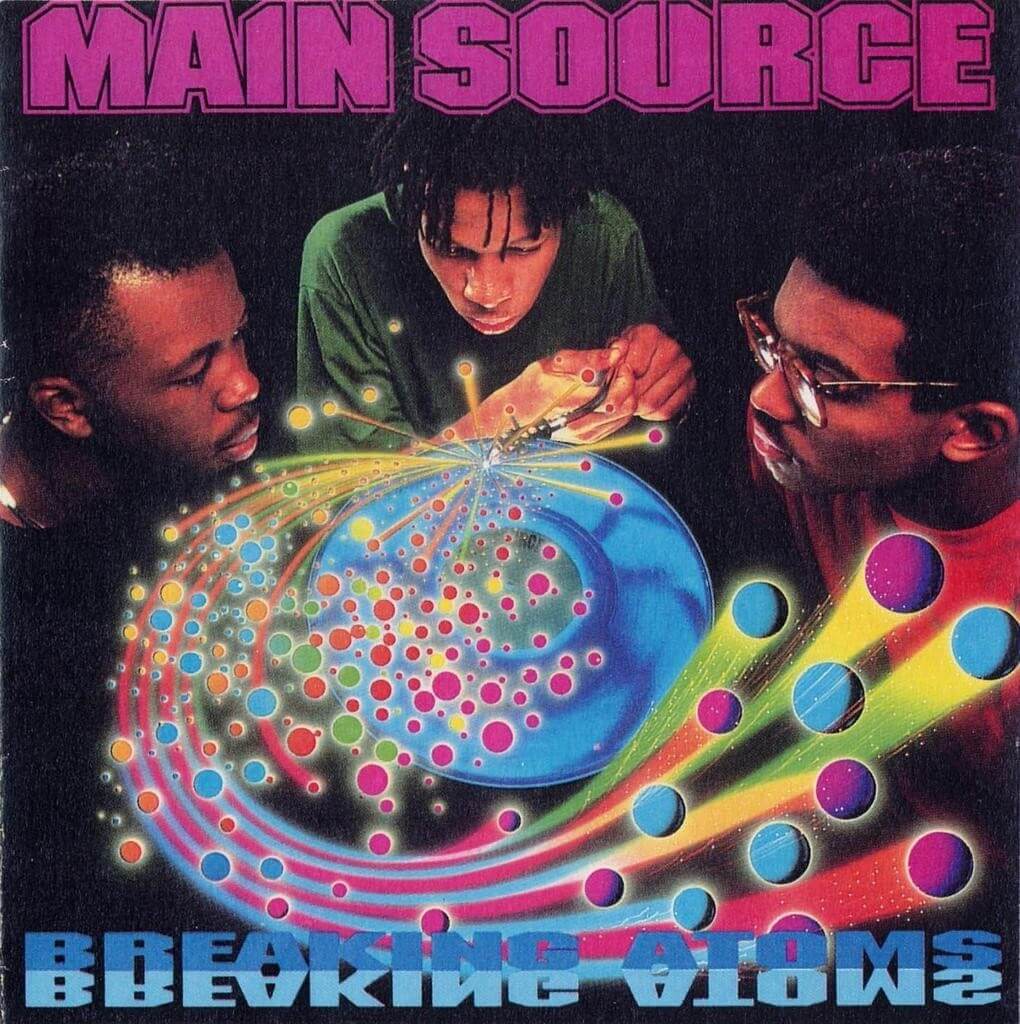
When Main Source released Breaking Atoms in July 1991, Hip Hop was entering a period of extraordinary creative growth. Sampling had become an art form in its own right, producers were pushing beyond the established formulas of the previous decade, and a new generation of MCs was bringing fresh perspectives to the microphone. Emerging from Queens, New York, Main Source arrived with an album that captured this moment with remarkable precision. Built around Large Professor’s inventive production, Breaking Atoms connected the funk-heavy foundations of Hip Hop’s past to the more intricate, jazz-inflected sound that would define much of the early 1990s.
Thirty-five years later, the album’s influence remains unmistakable. The Breaking Atoms (35th Anniversary Ultimate Collectors Edition) brings the original album together with an extensive collection of remixes, B-sides, instrumentals, collaborations, and previously unreleased material. Across 37 tracks and more than two hours of music, this edition offers an expanded view of Main Source’s creative world at a time when the group was helping reshape the sound of New York rap.
The original album remains the centerpiece. The additional material, however, makes this more than another anniversary reissue. It documents the production choices, alternate versions, and musical relationships that surrounded a record whose importance extends far beyond its initial release.
Large Professor: A Producer Ahead of His Time
Main Source began as a trio of Toronto-born producers and DJs K-Cut and Sir Scratch, alongside Queens native Large Professor, born William Paul Mitchell. The group brought together different regional backgrounds and musical experiences, but it was Large Professor who gave Breaking Atoms much of its distinctive identity.
Before the album appeared, Large Professor had already established himself as a formidable young talent. His early work with Eric B. & Rakim, particularly on their 1990 album Let The Rhythm Hit Em, placed him in the orbit of one of Hip Hop’s most important production partnerships. He contributed to the record’s title track, among other work, gaining experience in the studio while developing his own approach to sample-based production. His association with Rakim also connected him to the lyrical sophistication and rhythmic flexibility that would become central to his musical outlook.
Large Professor was still a teenager when he began making his mark as a producer. By the time he assembled Breaking Atoms, he had developed an ear for obscure records, unexpected musical combinations, and the smallest details that could transform a loop into something memorable. He understood how a fragment of an old funk, jazz, or soul recording could be rearranged into a beat with its own character, retaining traces of its source while becoming something entirely new.
His reputation would grow further through his later solo work, his production for Nas, and his influence on generations of beatmakers. Nas’s Illmatic, in particular, would reinforce Large Professor’s place in the history of New York rap. But Breaking Atoms captures the producer at an especially exciting point: young, adventurous, and working within a group that gave his ideas room to develop across an entire album. Large Professor was constructing a musical environment in which rhythm, texture, atmosphere, and vocal delivery worked together. The records could be playful, tense, reflective, or confrontational without losing their cohesion. His production had the detail of a seasoned crate digger and the confidence of someone who understood that a great beat did not need to announce every trick it contained.
The Art of Breaking Atoms
The album’s title is an apt description of its musical method. Large Professor approached sampling as a process of taking familiar musical elements apart and rebuilding them into new arrangements. Rather than relying on a single loop to carry an entire track, he could combine different fragments, isolate a brief instrumental phrase, or use a drum break to establish a rhythm before introducing additional layers.
This was not about making the samples sound as close as possible to their original recordings. It was about finding the right pieces and making them interact in unexpected ways. A bass line might provide the foundation, while a horn stab or keyboard phrase supplied the hook. Percussion could be rearranged to give the rhythm a different swing, and a short vocal fragment might become a recurring musical accent. The result was dense without becoming cluttered, with each element serving a clear purpose.
Large Professor also understood the importance of negative space. His beats leave room for the MCs to work, allowing a punchline, a change in cadence, or a particularly effective rhyme to register. The instrumental arrangements are detailed, but the vocals never have to fight against them. That balance is one of the reasons the album remains so satisfying on repeated listens.
The jazz influence is especially important, although Breaking Atoms is not a jazz-rap album in the narrow sense. Funk, soul, and other strands of Black American music run through its production. What distinguishes the record is the way these sources are handled: not as decorative references or background atmosphere, but as raw material for new compositions.
The album arrived at a moment when sampling technology and production techniques were opening up new possibilities. Large Professor’s work belongs to the same broader creative movement that included the innovations of Pete Rock, DJ Premier, Prince Paul, and Q-Tip. Each had a different musical vocabulary, but all understood that the producer’s role could extend beyond supplying a beat. The studio itself could become an instrument, and the sample could become the starting point for an entirely new piece of music.
Breaking Atoms stands out because its production is so distinctive without being self-conscious. The beats reward close attention, but their immediate appeal never depends on knowing where the samples originated or how they were assembled. The music works first. The craftsmanship reveals itself over time.
K-Cut and Sir Scratch: The Other Half of the Equation
Although Large Professor understandably dominates discussions of Breaking Atoms, the album’s identity cannot be separated from K-Cut and Sir Scratch. The two Toronto-born DJs brought their own production experience and turntable skills to the group, helping establish the collaborative approach behind Main Source’s music.
K-Cut, born Kevin McKenzie, was an accomplished beatmaker in his own right. His contributions helped shape the group’s approach to rhythm, arrangement, and sample selection, complementing Large Professor’s musical instincts. Sir Scratch, meanwhile, supplied the turntable work that gave the records additional movement and personality. The scratching on Breaking Atoms is never an afterthought. It functions as an integral part of the arrangements, punctuating verses, creating transitions, and adding another layer to the music.
The album’s production credits are generally attributed to Main Source collectively, with Large Professor responsible for much of its defining sound. Pete Rock also received a production credit for “Vamos a Rapiar.” This collaborative framework is worth remembering because Breaking Atoms was not the work of an isolated studio genius. It emerged from a group of musicians and DJs whose respective skills helped turn a collection of beats and rhymes into a fully realized album.
The chemistry is particularly apparent on “Scratch & Kut,” where the group’s turntable expertise takes center stage. Rather than treating the DJ as a supporting act, Main Source put the craft itself in the spotlight. The track celebrates the physical skill and musical imagination behind scratching, reinforcing Hip Hop’s connection to its DJ-led origins at a time when the MC was increasingly becoming the main attraction.
That balance between MC and DJ, between technical skill and musical expression, is one of the album’s defining qualities. Every component has a purpose, and none feels incidental to the finished record.
From Street-Level Observations to Personal Confessions
One reason Breaking Atoms has aged so well is its range of subject matter. Main Source could address social problems, tell stories, celebrate the culture, or explore personal frustrations without making the album sound like a collection of unrelated singles.
“Just Hangin’ Out” captures the relaxed, conversational side of the group. Its inviting groove and everyday subject matter evoke the social world surrounding Hip Hop: friends spending time together, exchanging stories, and enjoying the moment. There is no need for an elaborate narrative. The appeal lies in the track’s atmosphere and the ease with which the MCs inhabit it.
“Looking at the Front Door” moves in a different direction. The song deals with a relationship falling apart, with Large Professor describing domestic tension and emotional exhaustion in concrete, recognizably human terms. His delivery is controlled rather than melodramatic, and the production gives the subject enough space to breathe. It is one of the album’s most effective demonstrations of his ability to combine technical lyrical skill with genuine emotional observation.
The track also helped establish a template for personal storytelling in New York rap. Relationship troubles were hardly new territory in Hip Hop, but the combination of detailed writing, conversational delivery, and sophisticated production gave the song an unusual degree of intimacy. Large Professor sounds like someone working through a problem rather than performing a character for the listener.
“Just a Friendly Game of Baseball” is equally memorable, although its subject is far more serious. The song uses baseball imagery to describe police brutality, transforming an apparently familiar game into a disturbing account of institutional violence. The concept gives the track a clear narrative structure, while the lyrics make the underlying criticism impossible to miss. What makes the song effective is the discipline of the writing. The metaphor remains consistent, and the details accumulate until the listener understands the full implications of the comparison. Main Source manage to be direct without abandoning the creative wordplay that defines the album’s lyrical approach.
“Peace Is Not the Word to Play” is another highlight, addressing conflict and the consequences of treating violence as a game. Its title establishes the central point immediately, while the production provides a suitably forceful backdrop. Elsewhere, “Snake Eyes” and “He Got So Much Soul (He Don’t Need No Music)” demonstrate the group’s flair for more playful, rhythm-driven material.
The album’s range never becomes a liability because the musical identity remains consistent. Whether Main Source are discussing relationships, police violence, friendship, or Hip Hop itself, the production ties everything together.
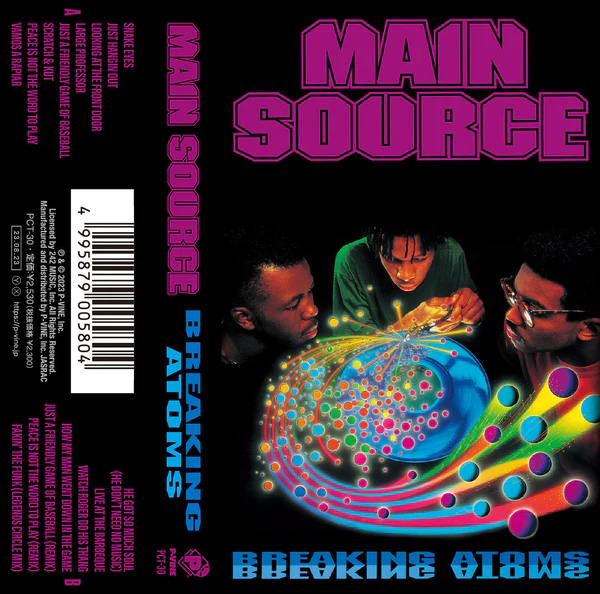
“Live at the Barbeque”: A Moment That Changed Hip Hop History
Few album tracks have acquired the historical importance of “Live at the Barbeque.” The posse cut features Large Professor, Nas, Akinyele, and Joe Fatal, and it remains one of the most celebrated showcases of early-1990s New York lyricism.
The track is especially significant because it introduced Nas to a wider Hip Hop audience before the release of Illmatic in 1994. His appearance here offers an early glimpse of the writer who would become one of rap’s most acclaimed lyricists. His verse is vivid, technically assured, and packed with the kind of imagery that would later define his debut album.
Nas was still a teenager, but he already possessed an unusual command of language and a talent for constructing memorable scenes in a limited amount of time. His contribution to “Live at the Barbeque” established him as a rapper worth watching, and its opening passage would later be referenced in “The Genesis,” the introduction to Illmatic. The connection between the two records makes this track an essential part of Nas’s artistic history.
Akinyele and Joe Fatal also make their presence felt, while Large Professor anchors the track with the authority of an established MC and producer. The result is a posse cut that succeeds on its own musical merits rather than relying on its eventual historical significance. That distinction matters. “Live at the Barbeque” would remain a classic even without Nas’s later career. The performances have energy and individuality, the beat is compelling, and the verses complement one another without losing their separate identities. Nas’s emergence adds another layer to an already outstanding record.
The track also illustrates Main Source’s importance as a platform for emerging talent. Large Professor’s studio work and musical connections placed him in a position to recognize promising MCs and give them the opportunity to make their mark. His later association with Nas would continue that relationship, but the foundation is already visible here.
In retrospect, “Live at the Barbeque” captures a moment before the next generation of Queensbridge rap fully emerged. Nas had not yet released Illmatic, and the musical landscape was still taking shape. Hearing the track today means hearing that future beginning to announce itself.
The Album’s Other Essential Cuts
The strength of Breaking Atoms extends well beyond its best-known songs. “Large Professor” is an extended demonstration of the producer’s own lyrical abilities. His writing is packed with wordplay and confident declarations, but the track never loses its sense of rhythm. The performance makes clear that his talents were not confined to the studio. He could construct a beat and command the microphone with equal assurance.
“Watch Roger Do His Thing” is another standout, combining a buoyant groove with a relaxed sense of humor. It provides a reminder that the group could be entertaining without sacrificing musical sophistication. “Vamos a Rapiar,” featuring Joe Fatal and produced with Pete Rock, adds another dimension to the album’s sound. The collaboration connects Main Source to another of the era’s great beatmakers, while the Spanish-language framing gives the track a distinctive identity within the record’s sequence.
“Peace Is Not the Word to Play,” “Snake Eyes,” and “Just Hangin’ Out” each demonstrate different aspects of the group’s production approach. One track can lean on a compelling groove, another on atmosphere, and another on a deceptively simple musical motif. There is no single formula behind the album’s success.
Even the title “Breaking Atoms” suggests a willingness to experiment with small elements until they produce something unexpected. The tracks feel related, but they are not interchangeable. That is an important distinction in an album built so heavily around sampling: the source material may come from the same broad musical traditions, but the finished compositions have their own personalities.
The result is an album that remains engaging from beginning to end. Its highlights are obvious, but the deeper cuts reward the listener who spends time with the entire record.
Why Breaking Atoms Was Ahead of Its Time
By 1991, Hip Hop had already produced an extraordinary run of influential albums. Public Enemy had expanded the political and sonic possibilities of rap, De La Soul had challenged its conventions, and A Tribe Called Quest had developed an approach that brought jazz and conversational lyricism into the foreground. Gang Starr, Pete Rock & C.L. Smooth, and other New York artists were exploring increasingly sophisticated production methods. Breaking Atoms belongs in this company, but its contribution is distinct.
Large Professor’s production helped establish a sound that would become central to East Coast rap throughout the 1990s. The combination of hard, distinctive drums, carefully selected samples, jazz and soul textures, and tightly arranged instrumental details anticipated much of the music that followed. The album did not invent sampling or jazz-influenced Hip Hop, but it demonstrated how far the approach could be taken when the producer treated each composition as an individual piece of music.
Its influence is particularly apparent in the work of later New York producers. Pete Rock developed his own rich, soulful sound, while DJ Premier became one of the defining architects of the boom-bap era. Large Professor’s work sits alongside theirs as a key part of that musical evolution. His influence was not limited to the records he produced himself; his techniques, musical sensibility, and studio knowledge helped shape the wider production community.
The album’s importance also lies in its combination of technical ambition and accessibility. Some records are admired primarily for their innovation, while others endure because of their songs. Breaking Atoms offers both. The production is sophisticated enough to reward close examination, but tracks such as “Just Hangin’ Out” and “Looking at the Front Door” remain immediately appealing. The lyrics are thoughtful without becoming ponderous, and the musical arrangements never obscure the performances.
That balance is difficult to achieve. An album can be technically impressive without being particularly enjoyable to revisit. Breaking Atoms has the opposite problem: its musicality makes it easy to overlook just how much is happening beneath the surface.
Its influence also reaches beyond production. The record’s willingness to combine social commentary, personal narratives, humor, and lyrical exhibitionism helped establish a model for the kind of full-length Hip Hop album that could accommodate multiple approaches without losing its identity. It belongs to the moment when the album was becoming an increasingly ambitious artistic statement, rather than simply a vehicle for a collection of singles.
And then there is Nas. His appearance on “Live at the Barbeque” connects Breaking Atoms directly to one of the most important debuts in Hip Hop history. Few albums can claim such a consequential early appearance by an artist who would go on to reshape the genre’s lyrical standards.
Breaking Atoms was ahead of its time because its innovations were not confined to one area. Its production, lyrical range, collaborative spirit, and ability to identify emerging talent all contributed to its lasting significance.
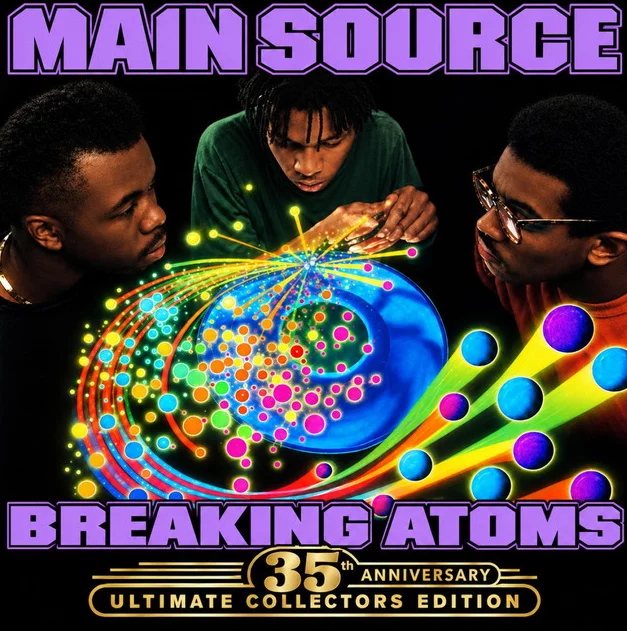
The 35th Anniversary Ultimate Collectors Edition
The Breaking Atoms (35th Anniversary Ultimate Collectors Edition) offers a welcome opportunity to revisit the album beyond its original twelve-track sequence. The 37-track collection includes the original album, remixes, B-sides, collaborations, instrumentals, and previously unreleased recordings, expanding the listening experience to more than two hours.
For longtime fans, the additional material provides a chance to hear familiar tracks in different contexts. “Just Hangin’ Out (Your Hood Remix)” and “Peace Is Not the Word to Play (Remix)” offer alternate interpretations of two established album highlights, while “Live at the Barbeque (Refried Remix)” revisits one of the group’s most historically significant recordings.
“Fakin’ the Funk” adds another piece to the picture, having appeared in the 1992 film White Men Can’t Jump. “Bonafied Funk,” featuring The Brand New Heavies, is another notable inclusion, bringing Main Source’s sample-based sensibility into contact with a British group whose own music drew heavily on funk, soul, and acid jazz. The collaboration highlights the musical connections that existed across scenes and genres during this period.
The collection also includes “How My Man Went Down in the Game,” “Atom,” and “Think,” expanding the view of Main Source’s output around the album’s release. The previously unreleased “Looking at the Front Door (Uncut Unreleased)” and “Time (Unreleased)” are especially intriguing additions for listeners interested in the group’s creative process. These recordings offer the possibility of hearing ideas that did not make the original album, rather than simply hearing familiar material in a new format.
The instrumentals are another major part of the package. They allow listeners to concentrate on Large Professor’s arrangements, the interplay between samples and drums, and the details that can become less obvious when the vocals are present. For aspiring producers and longtime beat enthusiasts, this material offers a closer look at the musical architecture of the record.
The remixes are equally valuable for understanding how Main Source approached their own compositions. Changing a beat or rearranging a sample can alter the character of a track without changing its underlying identity. Hearing these variations alongside the original versions helps reveal which elements were essential to each song and which could be reworked.
A collection of this size inevitably includes material that will interest dedicated fans more than casual listeners. Not every alternate version will compete with the original, and the instrumentals are best approached as an opportunity to explore the music rather than as substitutes for the finished songs. But that is precisely the point of an expanded edition: it provides a fuller context for a record that has already earned its place in Hip Hop history.
The anniversary edition’s real value lies in the broader picture it offers. The original album documents Main Source at their creative peak as a trio. The additional recordings reveal more of the surrounding work, the collaborations, and the musical ideas that helped define their brief but influential run.
A Classic That Still Sounds Alive
Main Source would not remain together in this original form for long. Large Professor eventually left the group amid business disagreements, while K-Cut and Sir Scratch continued with new MC Mikey D for F**k What You Think, released in 1994. Large Professor went on to build an important career as a solo artist and producer, contributing to records by Nas, Mobb Deep, Akinyele, and others.
That subsequent history makes Breaking Atoms all the more remarkable. It captures a creative partnership at the precise moment when its members’ talents came together to produce something exceptional. There was no long discography to dilute its reputation, and no second album from the original lineup to extend the story. What remains is a single, remarkably complete statement.
Thirty-five years on, Breaking Atoms still sounds like the work of musicians who understood the possibilities of Hip Hop and were eager to explore them. Its beats have weight without sacrificing detail. Its lyrics move easily between personal experience, social criticism, and playful braggadocio. Its turntable work reinforces the music’s roots, while its sampling techniques point toward the future.
The album’s influence can be traced through decades of New York rap, from the jazz-inflected boom-bap of the early 1990s to the increasingly intricate sample work of later generations. Its most famous guest appearance helped introduce Nas to the world, while Large Professor’s production and technical knowledge left a mark on the wider Hip Hop community.
The 35th Anniversary Ultimate Collectors Edition gives listeners an opportunity to hear the album in a broader context, with the original songs remaining as compelling as ever and the additional material opening new windows onto Main Source’s work.
Some records become classics because they define a particular moment. Others become classics because they help create what comes next. Breaking Atoms does both. It captures the energy of early-1990s New York Hip Hop while pointing toward the production and lyrical standards that would shape the decade ahead.
Its greatest achievement is that none of this sounds like homework. The beats knock, the rhymes stick, and the music invites repeated listening. The historical importance is undeniable, but the record does not depend on history to justify itself.
Thirty-five years later, Breaking Atoms remains a blueprint for what happens when sharp ears, technical skill, lyrical imagination, and genuine musical curiosity come together. This expanded edition offers a deeper look at that achievement, but the original album needs no restoration of its reputation. It has been a classic for decades, and it still sounds like one.