

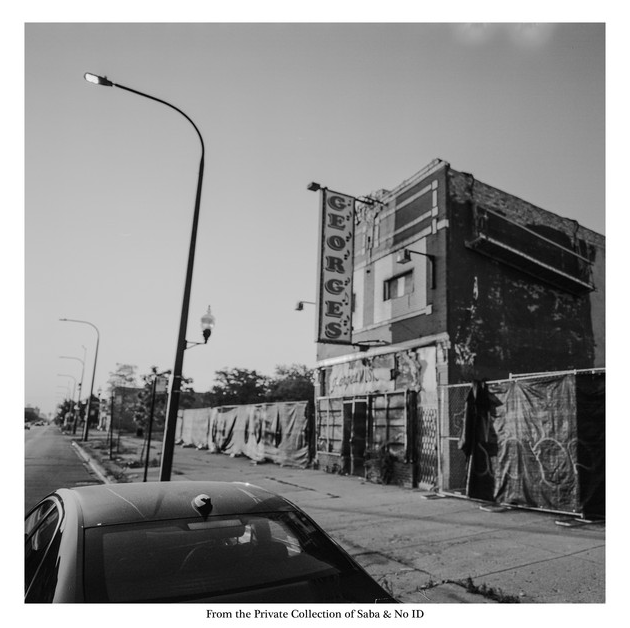
From The Private Collection Of Saba And No I.D. is an album built on groove, focus, and mutual respect. The production is steeped in soul, jazz, and dusty funk, with drums that knock and samples that swirl but never overcrowd. No I.D. stretches out across the tracks, flipping chords into loops that breathe, chop, and evolve without losing momentum. At its best, the music hits with the swing of classic Hip Hop and the precision of seasoned jazz players locked into the pocket.
This album was a long time coming. What started as a mixtape slowly expanded into a full-length collaboration, built over years of creative back-and-forth. Saba and No I.D. are from different generations, but their shared roots in Chicago Hip Hop culture give the record a strong foundation. No I.D., often called the godfather of Chicago Hip Hop, helped shape the city’s sonic identity in the ‘90s with artists like Common. Saba came up decades later, part of the YOUmedia era that birthed a new wave of introspective, independent rap voices. The connection isn’t just musical—it’s personal. No I.D. even discovered he had worked with Saba’s father years ago, a small detail that deepens the sense of lineage running through this record.
What’s striking about From The Private Collection is how loose and unforced it feels. Despite the weight of its names—despite the years of hype—it never sounds like it’s trying to prove anything. The mood is confident but calm, driven by curiosity and chemistry rather than ambition. Saba moves through these beats with ease. His voice sits low in the mix, conversational and steady, leaning into rhythms instead of chasing them. He sounds unbothered, even when the writing gets heavy. There’s clarity in his delivery—he’s not over-explaining or squeezing extra meaning into every bar. He lets the music carry some of the weight.
The album opens with “Every Painting Has A Price,” a groovy, sample-heavy cut that sets the tone for the production: warm textures, careful layering, and drums that feel live. Saba enters with poise, sliding over the beat while BJ the Chicago Kid and Eryn Allen Kane add harmony without turning it into a chorus-driven track. It’s not about hooks; it’s about mood and motion. The same approach runs through “Stop Playing With Me,” where Saba jokes about staying home in slippers over a piano melody that melts into a vintage soul loop. The sense of comfort is real. He’s not forcing big statements—he’s making space for smaller ones to land.
“head.rap” is one of the most playful tracks on the album. The beat bounces with light percussion and airy vocal chops, while Saba spins a story about learning to take care of his hair. It’s funny, specific, and quietly personal, the kind of song that sticks in your head without relying on punchlines. “Them neck braids helped you build backbone,” he raps, blending wit and self-reflection into the same line. He’s clearly enjoying himself here, but not in a way that undercuts the writing. The balance between humor and honesty is part of what makes his voice so distinctive.

No I.D.’s production is the throughline. He pulls from a deep archive of textures—chopped soul vocals, loose hi-hats, Rhodes keys, soft synth pads—but arranges them with intention. His beats don’t loop mindlessly; they breathe, shift, and open up space for the verses. On “Acts 1.5,” a song that lands somewhere between sermon and cipher, he slices horns into rhythmic fragments that double as percussion. “Reciprocity” brings in Ibeyi for a haunting, almost aquatic hook, with clicking snares and soft keys that ebb and swell behind Saba’s verse. Even when the samples are dense, the tracks never feel cluttered. There’s always air between the layers.
When the album turns darker, the tone shifts without throwing off the rhythm. “Stomping” rides a jagged guitar loop that gives the beat an edge, a sense of friction that pushes Saba’s verse into sharper territory. “30secchop” floats on a blurry vocal sample and heavy low-end, and Saba brings the focus inward: “I be thinking ‘bout the dead most times I chill.” On “How To Impress God,” the beat strips down to eerie percussion and echo, letting the silence between bars hit just as hard as the drums. These tracks are meditative without being moody. The tone is reflective, but the pace never drags.
There’s a clear sense of sequencing here. The album builds slowly, dips into looser, more impressionistic moments midway, then closes with a feeling of resolution. “Big Picture” and “She Called It” carry that middle stretch—shorter tracks that feel almost like sketches, built on mood more than structure. “Westside Bound Pt. 4” flips that energy, jumping into harder drums and sharper flows. It’s one of the most technical performances on the album, but still wrapped in a spirit of play. “From a land where they wanna get high and dance,” Saba raps, nodding to Chicago’s homegrown sounds—juke, bop, and drill—without trying to imitate them. It’s a moment of clarity, a reminder of where all this comes from.
Guest features are handled with restraint. When they appear, they add texture, not distraction. Raphael Saadiq and Kelly Rowland smooth out the bounce on “Crash” without flattening the beat. Frsh Waters and Tru lock into the groove on “She Called It,” adding energy without taking the track over. Smino’s appearance on the final song, “a FEW songs,” feels like a full-circle moment—Saba sounding relaxed but focused, bouncing off an old friend with natural chemistry. The features don’t feel like add-ons; they feel like part of the room.
The album title might suggest exclusivity—something rare, something stored away—but the music itself is open, welcoming, and generous. From The Private Collection doesn’t move like a high-concept project. It plays more like a conversation between artists who trust each other, working through ideas with patience and freedom. There’s no rush to impress. No need to over-declare purpose. Just two generations of Chicago Hip Hop quietly aligning, turning shared history into something alive and fully present.
Saba and No I.D. aren’t trying to recreate the past or predict the future. They’re simply tuned in to the now. And that clarity—musical, emotional, technical—is what holds the album together.
8.5/10
Also read: The Best Hip Hop Albums Of 2025
