

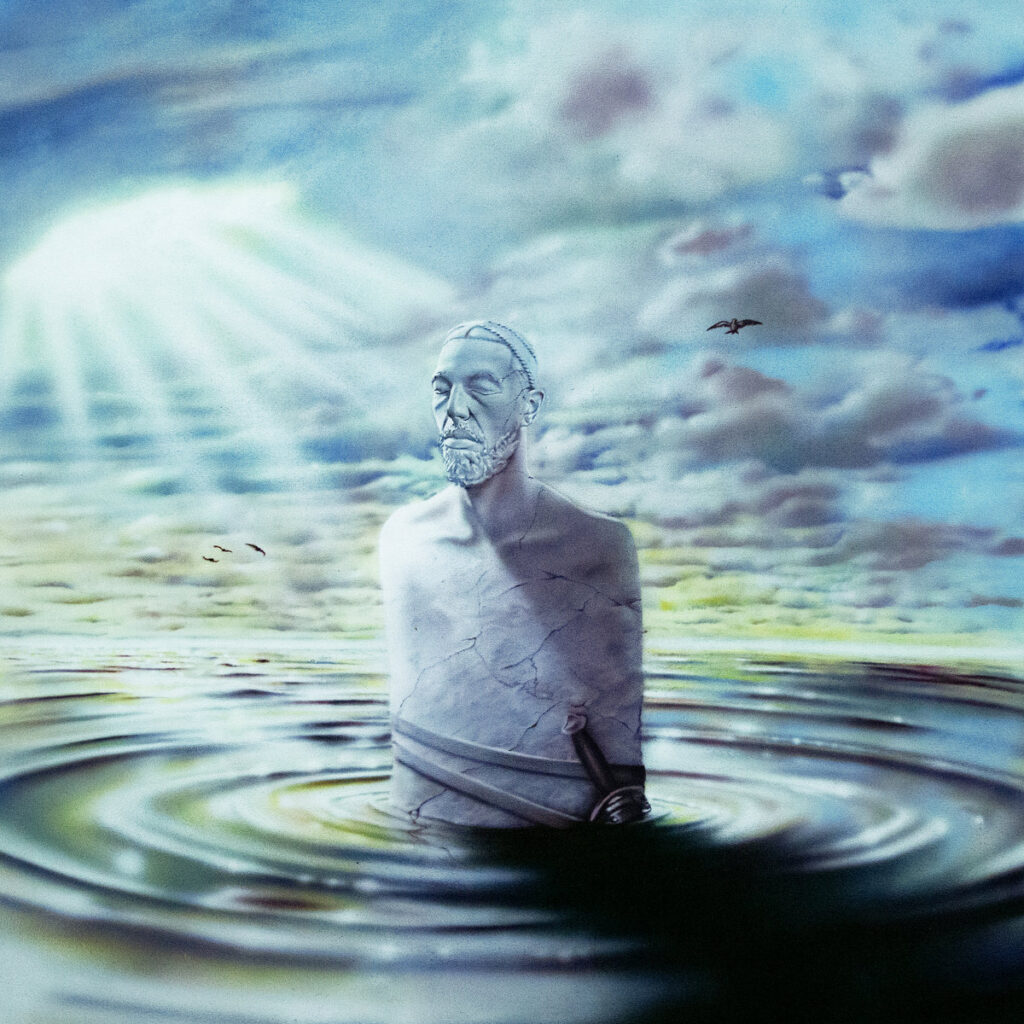
Navy Blue enters The Sword & The Soaring sounding steadier than ever—his voice clear, his pace unhurried, his focus absolute. Nearly a decade into shaping his own canon, he’s no longer searching for balance. He’s composing from it. After the introspective run from Song of Sage: Post Panic! through Ways of Knowing, and the concise meditation of Memoirs in Armour, this record feels like a culmination and a pivot. It collects the lessons he’s been repeating to himself—loss and faith, grief and restraint, abiding love—and renders them without the muffled haze that once defined his earlier tapes. Across sixteen songs, he moves with the calm of someone who understands his tools. The mysticism of old has evolved into grounded language.
“The Bloodletter” opens with sparse drums and a low, flickering bassline that feels like a heartbeat. Navy’s delivery is patient, confident, and inward-facing. He names the act of survival without dramatizing it, recounting wounds and the discipline it takes to move through them. The beat hums beneath him, carrying the same pulse as his words. That tone—of measured motion through pain—anchors the record.
“Orchards” extends that calm. The production by Child Actor leans on soft piano and distant vocal samples that sound lifted from a weathered reel. The air between sounds matters as much as the notes themselves. Navy raps with deliberate phrasing, turning private reflection into a kind of quiet mantra. Gratitude takes the place of despair, and grief transforms into work. The song refuses spectacle, choosing to rest in small affirmations.
On “Sunlight of The Spirit,” the lightness of the instrumental gives the record one of its most open spaces. A looping piano figure and barely-there percussion frame his words. He reflects on the act of growing up fast, of trying to find a sense of home in the heart rather than the house. It’s a moment of stillness that reveals how far he’s come as a writer—plainspoken, patient, unafraid to leave space where the listener can breathe.
That patience defines The Sword & The Soaring. Navy no longer rushes toward catharsis. On “God’s Kingdom,” he traces family history, connecting the pain of loss with the steady work of healing. The production again leaves room for reflection: gentle piano tones and brushed drums that linger in the air. Where earlier projects left grief unresolved, here he threads it through a sense of personal clarity. His writing has become more direct. He names experiences without turning them into myth, and that straightforwardness gives the album its quiet authority.
“If Only…” arrives as one of the most vulnerable tracks in his catalog. The beat fades to near silence, and the song unfolds like a conversation—part memory, part confession. He confronts expectations, regrets, and inherited pain without spectacle. The moment feels intimate, not performative. His voice carries the weight of accountability and forgiveness in equal measure. By the time the track ends, it feels like a private reconciliation overheard rather than performed.
In the second half of the record, Navy widens the lens to consider connection and legacy. “Soul Investments” turns toward family and lineage, speaking on cycles of care and the work of building something stable out of chaos. Sebb Bash’s bright guitar gives the track a lift that contrasts the heaviness of the subject matter. Navy allows wonder to exist beside exhaustion, shaping hope out of daily repetition. “Sharing Life” continues that idea, stretching one theme—love without possession—across a shimmering soul loop. His delivery is calm, his tone filled with gratitude for continuity rather than closure. The songs feel lived-in, closer to meditation than performance.
The album’s only feature, Earl Sweatshirt on “24 Gospel,” fits naturally into the flow. Produced by Animoss, the track uses a warm soul sample as a foundation. The collaboration reads like a dialogue between two craftsmen who understand the weight of their words. Earl’s verse feels like an extension of Navy’s thought process rather than a detour. The track becomes a reflection on endurance and transformation, with both rappers tracing their paths toward acceptance.
The production across The Sword & The Soaring remains consistent without falling into repetition. Child Actor, Chris Keys, Graymatter, Foisey, Malik, Jason Wool, Shungu, Sebb Bash, and others contribute beats that orbit the same tonal center—warm, dusty, soulful, and subtly spiritual. Even in its most stripped-down moments, the album never loses rhythm. The flow between songs feels organic, guided by instinct rather than structure. Each transition moves like a slow exhale.
By the time “The Phoenix” closes the album, the transformation implied by the title is complete. Navy approaches rebirth without mythologizing it. The production’s chimes and piano create the sensation of morning light after rain. His tone is gentle but certain, grounded in acceptance rather than escape. Instead of framing transformation as grandeur, he brings it down to human scale. The song refuses to reach for transcendence; it settles instead on discipline and continuity. The last lines sound like instructions to his future self, a reminder that peace is maintenance, not revelation.
What distinguishes The Sword & The Soaring from his previous work is its composure. The voice that once sounded cloaked in fog now speaks with clarity. He still works within the same palette—loose drums, dusty samples, meditative loops—but his relationship to silence has changed. Where older records wandered in introspection, this one moves with intention. It’s not a performance of wisdom but an application of it. The discipline in his phrasing mirrors the themes in his writing: patience, restraint, daily work toward alignment.
The influence of artists like the late Brownsville rapper Ka is evident in Navy’s pacing and phrasing—the quiet, deliberate meter, the use of breath as punctuation. He reaches toward accessibility without sacrificing depth, creating something closer to the spiritual openness of Killah Priest’s more meditative work, but Navy’s music is less esoteric and stripped of grandiosity. His tone is conversational, not didactic; his verses sound like lived philosophy.
Across his catalog—from Àdá Irin through Memoirs in Armour—Navy Blue has built a language rooted in repetition and reflection. The Sword & The Soaring adds another strong chapter to that story, one that refines rather than reinvents. It is an album about steadiness, about learning to remain in place without stagnation. The production choices reinforce that ethos: warm keys, soft percussion, no unnecessary motion. Even the sequencing feels deliberate, guiding the listener through cycles of reckoning, gratitude, and release.
There’s a quiet confidence in how Navy carries himself here. He doesn’t perform suffering for validation, and he doesn’t frame peace as an endpoint. Instead, he shows the act of maintenance—how clarity can coexist with exhaustion, how love can survive repetition. His writing moves toward utility: phrases meant to be lived with rather than admired from a distance.
In a landscape where abstraction often drifts into obscurity, Navy Blue offers clarity without compromise. He raps about healing, discipline, and love without sentimentality. The music is spiritual without preaching, personal without exhibition. The Sword & The Soaring is not only another strong entry in his catalog—it may be his finest. It confirms Navy Blue as one of the essential modern voices in Hip Hop’s ongoing conversation about growth, pain, and transcendence through art.
8.5/10
Also read: The Best Hip Hop Albums Of 2025
Thanks for reviewing Navy Blue.
Why did you sleep on him and never reviewed his other albums?